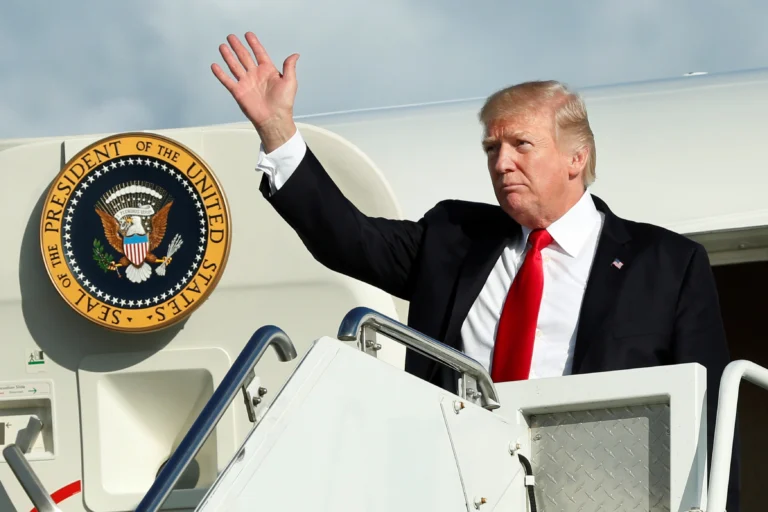
Washington, DC – US President Donald Trump made sharp and surprising remarks reflecting the depth of the behind-the-scenes disagreements between Washington and Tel Aviv, strongly criticizing Israeli military tactics in Lebanon. He asserted that Israel has been fighting Hezbollah for “far too long” and suggested that Damascus should be allowed to “take care” of the entire issue. In response to a question about Israel’s refusal to withdraw from southern Lebanon, a stance that threatens the diplomatic framework for ending the war, Trump described the conflict in Lebanon as a “small war,” contrasting it with the “big war” with Iran.
On the sidelines of the G7 summit in France, Trump expressed his deep displeasure with Israel’s demolition tactics. He said, “A lot of people are being killed. You don’t have to demolish an entire apartment building every time you’re looking for someone. Not everyone there is Hezbollah.” He added, “I suggest Israel let Syria take care of Hezbollah. I think they’re doing a better job.” He also openly criticized Tel Aviv for launching an attack on Lebanon “just two hours before the agreement was signed.”
Assad and Sharaa: A shifting power equation in Damascus
Trump’s call to involve Damascus in curbing Hezbollah’s influence comes at a time when Syria is undergoing radical transformations. After decades of former dictator Bashar al-Assad’s alliance with Tehran and Hezbollah, his regime was overthrown in December 2014 by a Sunni Islamist alliance led by current President Ahmed al-Sharaa.
Behind the scenes of the clash between Trump and Netanyahu
Regarding reports of a heated exchange of accusations with Benjamin Netanyahu, Trump denied any personal frustration. However, he added, in a strongly worded but veiled message: “Our relationship is great, and we’re discussing the final details, but without us, without the United States, and without me personally, there would be no Israel, because no other president has been willing to do what I have done… And now Bibi needs to be more responsible toward Lebanon.”
Cracks in the Strategic Front: Instead of presenting a united front against Tehran, the agreement revealed a deep divide. Trump seeks to resolve the conflict diplomatically, while Netanyahu views Tehran as an existential threat and refuses to limit his military options.
Iran had stipulated that the agreement include a limit on Israeli operations in Lebanon, causing significant friction, especially after Trump personally asked Netanyahu to refrain from striking Beirut during the negotiations to avoid undermining the diplomatic initiative.
Conversely, there is widespread discontent in Israeli circles. Reuters quoted a senior Israeli official describing the agreement as “terrible for Israel.” He confirmed that this position is now shared by all political and military leaders in Tel Aviv. Furthermore, Netanyahu’s government insists on retaining the right to unilaterally respond.