Tel Aviv, Israel – In field accounts revealing some of the complexities of the ongoing military operations in southern Lebanon, soldiers from the Israeli army’s “Multi-Dimensional Unit” spoke about the size of Hezbollah’s military arsenal. They also described the tactics employed by Hezbollah fighters against ground forces during the recent incursion.
A massive arsenal that exceeds expectations
The Israeli newspaper Maariv quoted soldiers who participated in crossing the Litani River and capturing Beaufort Castle as saying they were shocked by the quantity of weapons Hezbollah fighters left behind during their withdrawal.
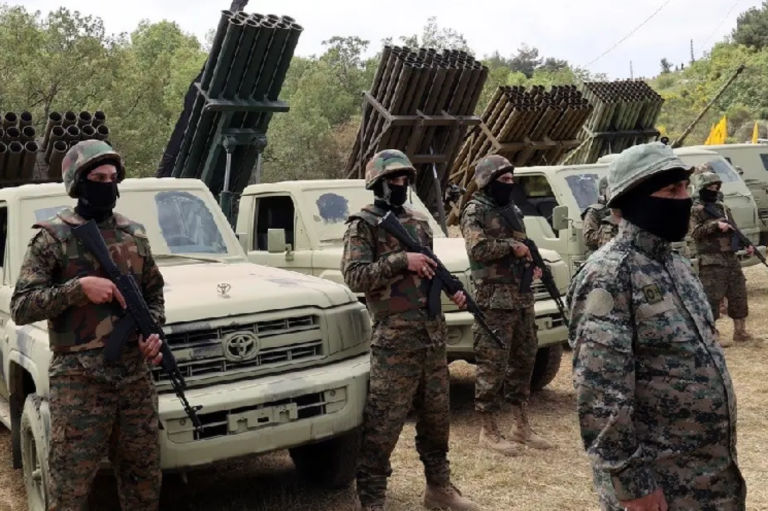
The soldiers confirmed that they found hundreds of rocket launchers, drones, anti-tank missiles, rifles, and protective vests scattered across strategic hills.
Describing one of the discovered sites, a soldier said, “We reached a huge enclosure in a village north of the Litani River, the size of a football field; in the center was a truck loaded with rocket launchers, fully prepared to strike the Galilee region within minutes.”
These testimonies support the hypothesis that Hezbollah had a large-scale military infrastructure prepared in advance of the recent clashes.
Remote combat tactics and drones
Regarding the nature of the confrontation, the Israeli soldiers acknowledged that Hezbollah does not engage in direct battles or conventional engagements. Instead, it employs a strategy of “remote warfare.” The fighters explained that Hezbollah operatives identify the positions of Israeli forces and then target them intensively using explosive-laden drones, Kornet anti-tank guided missiles, and other guided missiles. The soldiers stated, “We are launched at an explosive-laden drone almost every hour, which has forced us to develop complex tactical plans to counter this constant threat, especially since our objective is to penetrate deep into the area and dismantle Hezbollah’s drone unit.”
The soldiers considered that crossing the Litani River was not just a military advance, but rather a “turning event” that removed a psychological barrier that had restricted the movement of the Israeli army for decades.
Maariv described the “multi-dimensional” unit as being the tip of the spear that crossed the river. After that, the way was opened for the Golani Brigade and the 7th Brigade to advance towards Beaufort Castle and control the heights that control the joints of the region.
These testimonies come after nearly 30 days of intense fighting, coinciding with a brief truce secured by the forces in the past 24 hours. These accounts reflect the mutual attrition in southern Lebanon. Meanwhile, Israeli forces continue their attempts to impose a new reality on the ground deep inside Lebanon, facing resistance that relies on technology and fortified positions.