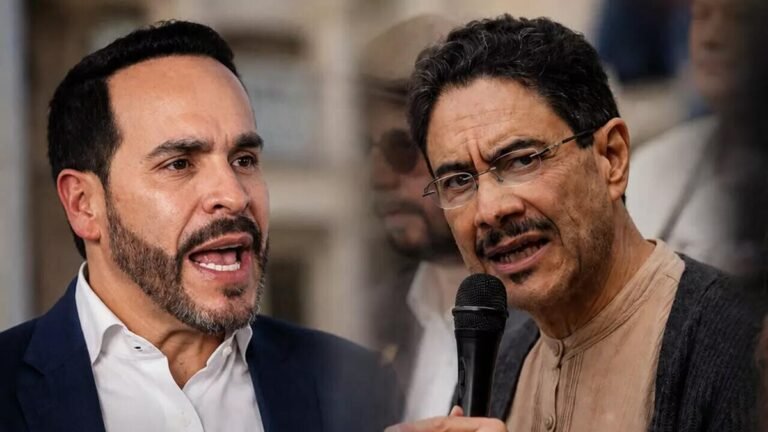
Bogotá, Colombia – Colombia’s first-round presidential election was decided late Sunday night, with Abelardo de la Esperilla and Iván Cepeda officially advancing to the runoff after more than 99% of the votes were counted.
The results underscored the deep polarization and ideological divide in the country. Colombian society is split between the far-right and the ruling left-wing parties.
Close results and an open race
Official results showed that De la Esprilla, the independent candidate backed by the right-wing Defenders of the Homeland movement, led the race with 43.73% of the vote. He was followed by Iván Cepeda, the candidate of the left-wing Historical Pact coalition and an ally of current President Gustavo Petro, with 40.91%.
Meanwhile, Paloma Valencia, the Democratic Center party candidate, was eliminated from the race after receiving only 6.92% of the vote.
Since no candidate secured the 50% required to win outright in the first round, the electoral authorities scheduled a runoff election for June 21, 2026. This runoff will determine the next president of Colombia for the 2026-2030 term.
Program clash: “Iron Fist” vs. “Comprehensive Peace”
The runoff election represents a clash between two opposing visions for the country’s future. De la Esperilla, known as “El Tigre” (The Tiger), adopts a rhetoric politically aligned with Donald Trump’s model. He advocates for an “iron fist” approach to security, including the construction of 10 massive prisons in the jungle, similar to El Salvador’s model. Economically, he focuses on reducing government spending and providing tax breaks for large corporations.
On the other hand, Cepeda champions the slogan of “comprehensive peace,” relying on diplomatic dialogue and negotiations with armed groups as a strategic option for ending conflicts.
His program focuses on expanding social spending, supporting renewable energy, and distributing land to small farmers and victims of Colombia’s historical armed conflict.
Alliances and fears of skepticism
On the political front, the right-wing camp received a significant boost immediately after the results were announced. Candidate Paloma Valencia declared her unequivocal support for De La Esperilla in the runoff election, urging her supporters to unite against what she termed “neo-communism.”
Meanwhile, tension gripped the left-wing camp. President Gustavo Petro and candidate Cepeda sparked widespread controversy after refusing to immediately accept the preliminary results, stating they would await the completion of the official count and verification process by the relevant committees. They also expressed doubts about the accuracy of the announced figures.
These developments place Colombia in the midst of weeks of political uncertainty. Alliances and populist rhetoric will play a pivotal role in determining the outcome of the most contentious presidential race in the country’s modern history.