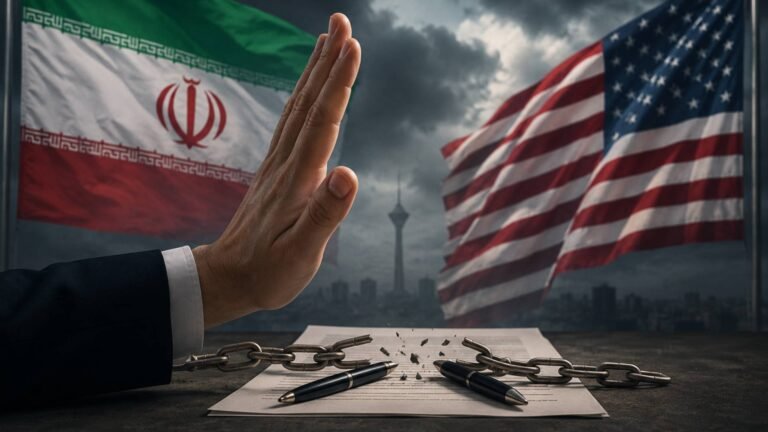
Washington, DC – In a significant escalation of the Trump administration’s “maximum pressure” campaign, the US Treasury Department’s Office of Foreign Assets Control (OFAC) announced on Thursday a new and sweeping package of sanctions targeting Iranian oil sales networks that fund the military establishment. These measures are an integral part of the “Economic Fury” strategy, which aims to cut off the Iranian regime’s funding sources for its destabilizing activities.
Direct targeting of the military establishment
The U.S. Treasury Department confirmed that the Iranian regime relies heavily on crude oil sales—particularly to China—to finance the rebuilding of its armed forces and the development of its military capabilities. According to the official statement, the Iranian military operates a complex network of shell companies and intermediaries, especially in Hong Kong. This network circumvents international sanctions and generates billions of dollars in revenue.
The Treasury Department highlighted the Sepehr Energy Jahannameh Pars Company, describing it as the “oil sales arm” of the Iranian Armed Forces General Staff. The sanctions also targeted several intermediary companies in Hong Kong, including one involved in transporting hundreds of thousands of barrels of gasoline into Iran. This represents a significant blow to the supply chains relied upon by the Islamic Revolutionary Guard Corps (IRGC).
The “arteries” of the regime under scrutiny
In the same vein, US State Department spokesman Tommy Pigott announced that the United States is taking “coordinated action” to cut off Tehran’s access to revenues used for “regional aggression and global terrorism.” Pigott explained that the department designated eight entities as “blocked assets” for transporting Iranian oil or petrochemical products. Furthermore, it imposed sanctions on other individuals and entities involved in this “backbone of the illicit oil economy.”
The US State Department confirmed that this move directly targets the financial arteries of the Islamic Revolutionary Guard Corps and the regime’s military establishment. Furthermore, the department indicated that Tehran uses this illicit trade to fund its operations throughout the Middle East.
Treasury Secretary: We will not allow the rebuilding of military capabilities
In a firm statement, U.S. Treasury Secretary Scott Besant said, “The Treasury Department will continue to pressure Iranian oil sales to deny the regime and its military the financial resources they need to threaten America’s allies and partners in the region.” Besant added, “We will not allow the Iranian regime to increase its oil revenues to rebuild its armed forces and military capabilities.”
These actions are based on the legal authority to combat terrorism (Executive Order 13224) and pursuant to President Trump’s directives establishing a comprehensive economic pressure campaign. Since the inception of this strategy, Washington has frozen hundreds of millions of dollars linked to the regime. It has also worked to disrupt global banking networks that provided cover for Iranian activities.
$15 million for “crucial information”
To bolster these efforts, the U.S. State Department’s Rewards for Justice program renewed its offer of rewards of up to $15 million for information leading to the disruption of the financial mechanisms of Iran’s Islamic Revolutionary Guard Corps (IRGC) and its various branches. This offer is part of Washington’s efforts to engage the international community in exposing the money laundering networks and shell companies used by the IRGC to circumvent sanctions.
The US administration insists that these measures are not merely economic restrictions, but rather a “financial blockade” aimed at compelling the regime to change its regional behavior and halt its military and nuclear programs. With tensions on the ground persisting, the “economic pressure” strategy remains Washington’s primary tool for exerting pressure on Tehran without resorting to a full-scale military confrontation, unless the latter crosses the “red lines” clearly drawn by the US administration in recent days.