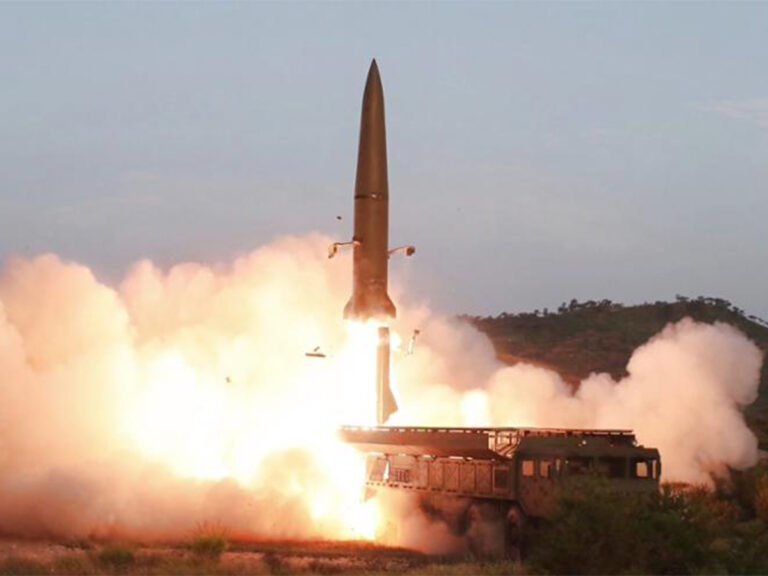
Pyongyang, South Korea – In a move indicating continued tensions on the Korean Peninsula, the South Korean military announced in an official statement that North Korea launched several missiles on Tuesday. Among these was at least one short-range ballistic missile, which was fired into the waters off the country’s west coast in the Yellow Sea.
The South Korean Joint Chiefs of Staff stated that the launch occurred at approximately 4:00 AM GMT. The missiles were launched from North Pyongan Province.
This launch marks Pyongyang’s first known missile test since April 19, when it conducted a short-range ballistic missile test, claiming it was equipped with cluster munitions.
These developments come amidst an escalating pattern. In early April, Pyongyang announced tests of a new cluster bomb warhead and also conducted an electromagnetic pulse weapon test. Analysts suggest these actions reflect the North’s persistent efforts to demonstrate its capabilities in modern warfare and advanced technologies. These missile tests also follow assertive statements made by North Korean leader Kim Jong Un in March, in which he affirmed that his country’s status as a “nuclear state” was irreversible. He emphasized that expanding its nuclear force was essential for national security and the regime’s survival.
Meanwhile, North Korea is undergoing significant political and constitutional transformations. At the beginning of May, Pyongyang unveiled sweeping constitutional amendments that reshape the country’s strategic vision.
These amendments represent a radical shift in the country’s stance on Korean reunification, removing the phrase “peaceful reunification,” which had been a cornerstone of previous versions of the constitution. Furthermore, other slogans, such as “complete victory of socialism,” were also eliminated. The constitutional amendments carry profound political implications, granting leader Kim Jong-un broader powers and reaffirming the central role of nuclear weapons in the state’s strategy.
One of the most significant geopolitical changes in the new constitution is the demarcation of borders with neighboring countries. The constitution defines the country’s borders with China and Russia to the north, and with the Republic of Korea (South Korea) to the south.
Analysts point out that this demarcation represents an implicit recognition of South Korea as an independent state, a remarkable shift, especially since the 2019 constitution made no mention of the South. This military escalation, coinciding with the constitutional changes, confirms that Pyongyang is adopting a new security and political doctrine. This doctrine redefines its relations with its regional neighbors and places its nuclear arsenal at the heart of its survival strategy.