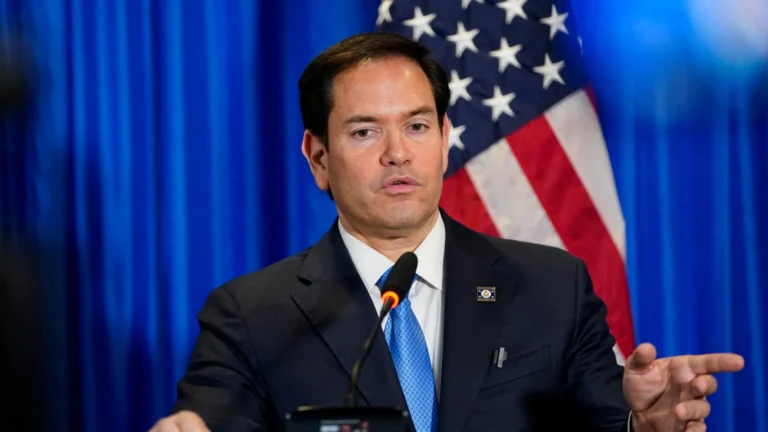
New Delhi, India – In a strong indication of an imminent major diplomatic breakthrough, US Secretary of State Marco Rubio announced on Sunday that the world could see “good news” regarding a potential agreement with Iran within the next few hours.
Rubio’s remarks to reporters in New Delhi underscored the positive momentum in the negotiations, which are being led by President Donald Trump.
Addressing the Strait of Hormuz crisis and the nuclear issue
Rubio explained that the emerging agreement focuses primarily on addressing U.S. concerns regarding the Strait of Hormuz, which has seen a large-scale Iranian closure in response to recent military operations.
The U.S. Secretary of Defense added that the agreement aims to launch a long-term diplomatic process. This process will ultimately lead to achieving President Trump’s strategic goal: “creating a world that no longer has to worry about an Iranian nuclear weapon.”
This statement coincides with assurances from President Trump, who announced a series of intensive talks with regional leaders. He indicated that the peace efforts were in their final stages, and work is now focused on “finalizing the text of the agreement.” There is a firm commitment to reopening the shipping lanes in the Strait of Hormuz.
Iranian official warned: “The nuclear issue remains postponed.”
Despite American optimism, Iran’s stance is marked by extreme caution. Reuters quoted a high-ranking Iranian source as saying that Tehran has not agreed to hand over its stockpile of highly enriched uranium. The source emphasized that the nuclear issue “was not part of the current preliminary agreement.”
According to the Iranian news agency Tasnim, affiliated with the Revolutionary Guard, Iran has not accepted any executive measures in the nuclear field at this stage. These negotiations have been postponed until after the end of the war and will be considered only after the United States takes concrete steps.
The Iranian perspective emphasizes that the cornerstone of the current agreement is Washington’s commitment to suspending oil sanctions. This suspension allows Tehran to restore its ability to export oil without restrictions.
As the official announcement draws near, global markets and international political circles are eagerly awaiting the details of the anticipated memorandum of understanding. This memorandum is seen as a pivotal step that could redraw the map of influence and interests in the Middle East. It could also bring an end to one of the most turbulent periods in global energy markets resulting from the conflict that has raged since last February.