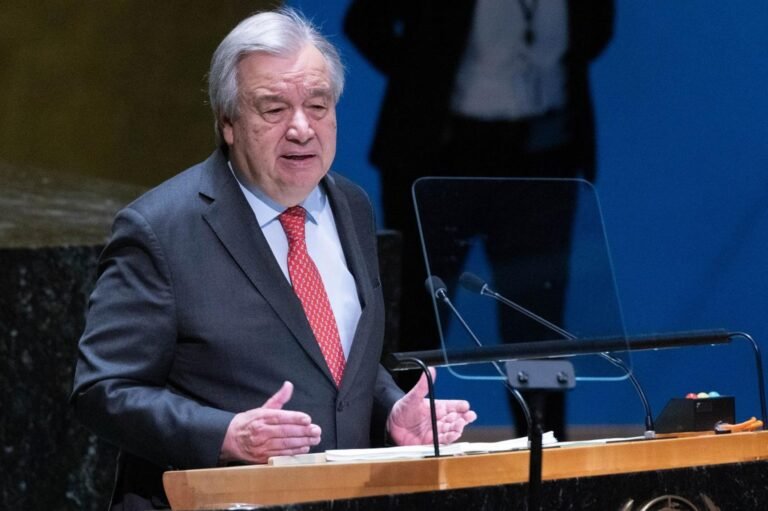
New York, USA – UN Secretary-General António Guterres expressed his deep disappointment that the 11th Review Conference of the Treaty on the Non-Proliferation of Nuclear Weapons (NPT) failed to reach a consensus on a final document and a tangible outcome.
A UN spokesperson quoted Guterres as saying that “a vital opportunity to help strengthen global security and make the world a safer place has been lost.” This comes at a time when the risk of nuclear conflict is escalating globally to unprecedented levels.
Iranian accusations against “Washington and its allies”
Meanwhile, the halls of the United Nations witnessed a heated exchange of accusations. The mission of the Islamic Republic of Iran to the United Nations in New York issued a strongly worded official letter, describing the failure of the eleventh review conference as a direct result of what it called “the systematic sabotage by the United States and its Western allies.”
The Iranian mission asserted in its statement that “excessive” and unrealistic American demands, and Washington’s attempts to impose its own political agenda, prevented any convergence of views among member states. This ultimately led to the freezing of the final agreement.
The Iranian delegation participating in the conference warned of the future repercussions of this failure, noting that in the absence of serious and genuine steps toward nuclear disarmament by the major powers, the future of the entire Treaty on the Non-Proliferation of Nuclear Weapons would be worrying, uncertain, and “unthinkable.” It also pointed out that the continuation of double standards threatens the collapse of the entire arms control system.
A no-consensus conclusion in New York
The eleventh review session of the Treaty on the Non-Proliferation of Nuclear Weapons (NPT), held from May 27 to June 14 at the United Nations Headquarters in New York, concluded on Friday without reaching the consensus required to adopt the final document.
Over the three weeks of the conference, diplomatic delegations failed to overcome the deep divisions surrounding disarmament and international control issues. This reflects the current crisis facing collective security treaties in the context of sharp international polarization.