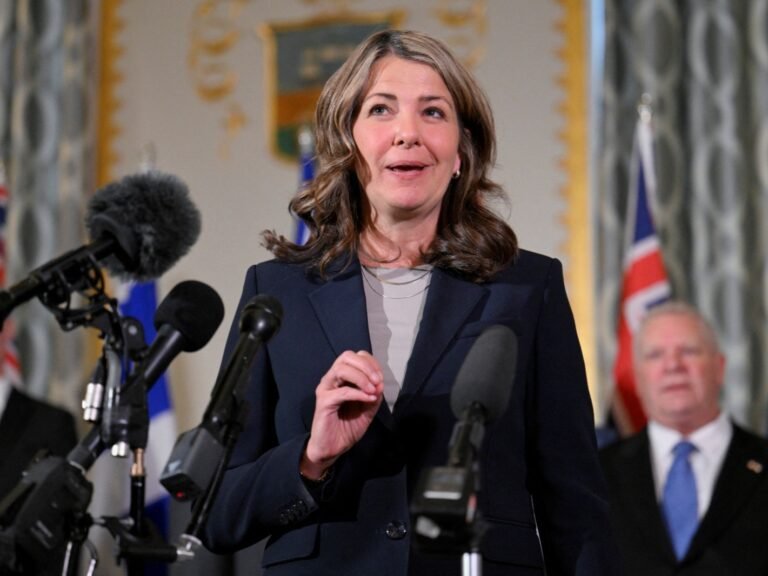
Edmonton, Alberta – In a dramatic political development that threatens the future of the Canadian federation, Alberta Premier Danielle Smith announced she will formally call for a referendum to determine whether the energy-rich province will remain part of Canada or begin a legal and constitutional process that could ultimately lead to its full independence and separation from the Canadian state.
The timing of the referendum and the wording of the alternative question
According to a Bloomberg report, this crucial vote is scheduled for October 19. This move comes in response to mounting pressure and on-the-ground activism led by hardline separatist groups actively seeking to secede from Canada. A pressure group known as Stay Free Alberta had previously attempted to force a direct referendum on secession, relying on a local law that allows citizens to compel the government to hold a public vote through petitions. However, a provincial court in Alberta blocked this attempt last week, ruling that the government had failed in its constitutional obligation to consult with First Nations before proceeding with such a significant legislative change.
To avoid a legal challenge, Smith’s government decided to include a carefully worded alternative question on the ballot: “Should Alberta remain a province within Canada, or should the Alberta government initiate the legal process required by the Canadian Constitution to hold a binding provincial referendum on whether Alberta should secede from Canada?”
In a televised address to the nation, Smith affirmed that her personal position, and that of her United Conservative Party, clearly supported remaining within Canada. She also emphasized her deep concern over what she called a “flawed” court decision that infringed upon the democratic rights of the hundreds of thousands of citizens who had signed the petition.
A sharp division within the separatist camp
Despite Smith’s legal maneuver to avoid an immediate confrontation with the courts, the wording of the new question sparked outrage among separatist leaders. Geoffrey Rath, a prominent figure in the separatist movement, described the change as a “stab in the back” to the 301,000 citizens who signed the petition and braved harsh weather and freezing temperatures to press their demands. He also threatened to lead a major campaign to oust Smith from the party leadership at the earliest opportunity.
In contrast to this outcry, opinion polls indicate that separatist sentiment does not enjoy majority support. A recent poll by Janet Brown Research showed that only 27% of the population supports secession, while 67% oppose it. Meanwhile, the anti-secessionist Forever Canada movement, led by former Deputy Prime Minister Thomas Lukaszek, has gathered over 400,000 signatures in support of national unity.
Economic weight and the positions of political forces
Alberta, with a population of approximately 5 million, is the economic heart of Canada, holding most of the country’s oil reserves and exporting millions of barrels daily to the United States.
Despite this constitutional crisis, Smith recently signed an agreement with the government of Canadian Prime Minister Mark Carney to move forward with a new pipeline project to the west coast. Construction is scheduled to begin in September 2027. In response, Sheldon Sunshine, leader of one of the Indigenous groups that challenged the initial referendum, affirmed that they are organized and prepared to continue the legal and public fight against any move to break up the province. For his part, Minister of Government Affairs Dominic LeBlanc expressed Ottawa’s desire to build a stronger Canada in partnership with Alberta. Meanwhile, the leader of the opposition Conservative Party, Pierre Poilievre, announced that he would be campaigning to support the “Remain” campaign and promote national unity.