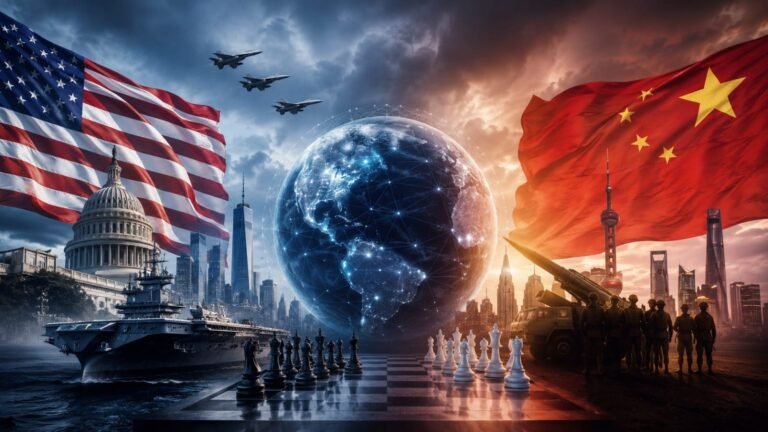
Washington, DC – An analysis by the Center for Strategic and International Studies, the Brookings Institution, and the Council on Foreign Relations indicates that the international system is heading toward a transitional phase over the next decade. This shift is characterized by a relative decline in US hegemony and the rapid rise of China. This opens the door to five main scenarios for reshaping the global balance of power through 2035.
First: A bipolar world (a new Cold War)
According to analyses by the Center for Strategic and International Studies (CSIS), the world is heading toward a potential split between a US-led axis and a China-led axis, resembling a new Cold War but waged with economic and technological tools.
Washington, according to reports from the Brookings Institution, is seeking to strengthen alliances, impose restrictions on Chinese technology, and relocate production chains. Meanwhile, Beijing is working to expand its global economic and military influence and reduce its dependence on the West.
These assessments indicate that the most significant flashpoints will remain related to Taiwan. Competition is also expected to intensify in artificial intelligence and supply chains. This could lead to a clear global economic division.
Second: A multipolar world
Studies by the Council on Foreign Relations and the Atlantic Council predict a decline in the unipolar hegemonic model in favor of a multipolar system. In this system, power is distributed among the United States, China, the European Union, India, and Russia. It also includes emerging blocs such as BRICS.
This scenario implies a more flexible, but also more volatile, system of international relations. It also sees an increased role for middle powers such as Saudi Arabia, Turkey, and Brazil in managing the balance of power among the major blocs.
Third: The continuation of American supremacy
Despite China’s rise, reports from the RAND Corporation and the Council on Foreign Relations indicate that the United States still possesses elements of structural superiority. The most important of these advantages are the strength of the dollar, its network of military alliances, and its dominance in advanced technology and scientific research.
Conversely, these same analyses point to challenges facing China, such as slowing growth, a real estate crisis, and demographic shifts. This could allow the United States to maintain its dominance until 2035. However, the United States may not be able to maintain the absolute hegemony that characterized the post-Cold War era.
Fourth: The possibility of a military clash between the major powers
Studies by the Center for Strategic and International Studies (CSIS) warn that the most dangerous scenario is a direct military confrontation between the United States and China, particularly over Taiwan.
These studies suggest that any conflict in East Asia could lead to widespread disruption of the global economy. It could also cause a collapse in supply chains. Furthermore, a severe crisis in energy and technology markets could erupt. Both sides are expected to suffer enormous losses even without nuclear escalation.
Fifth: The rise of technology and giant corporations
Reports from the World Economic Forum and the Atlantic Council indicate a gradual shift in the nature of global power. This shift is fueled by the rise of artificial intelligence companies, data platforms, and digital infrastructure as key players in the international system.
This transformation means that influence is no longer solely the domain of states. Instead, it is now distributed among governments and giant corporations that control data, artificial intelligence, and knowledge chains.
The Middle East at the heart of transformations
Analyses by the Brookings Institution and the Center for Strategic and International Studies indicate that the Middle East will transform into an arena of strategic competition between Washington and Beijing, replacing the traditional American hegemony.
The United States is expected to maintain its military superiority. China will also expand its economic and investment influence, while the Gulf states will adopt policies to balance between the two powers. Regional powers such as Egypt, Turkey, and Saudi Arabia will strive for greater strategic independence.