Washington, DC – Amid escalating tensions in vital waterways, new field and political data have emerged indicating that control of the Strait of Hormuz now directly depends on a decision from the White House. Meanwhile, intelligence warnings suggest that the Iranian threat remains despite successive military strikes.
Conricus: The key to the strait is in Trump’s hands
Jonathan Conricus, a former spokesperson for the Israeli military, stated on the X platform that the Strait of Hormuz remains effectively closed to international shipping. Conricus explained that the current situation will persist until a direct order is issued by US President Donald Trump to reopen it.
Conricus indicated that operational plans are ready for implementation. He affirmed that, upon receiving presidential directives, U.S. Central Command (CENTCOM) will immediately commence a large-scale military operation to secure the waterway and reopen it to oil tankers and global trade. This reflects the extent of the mandate granted to U.S. forces in managing this crisis.
Hudson Institute: The threat of naval “guerrilla warfare”
On the other hand, the Hudson Institute in the United States published an in-depth analytical report warning against underestimating Iran’s remaining capabilities.
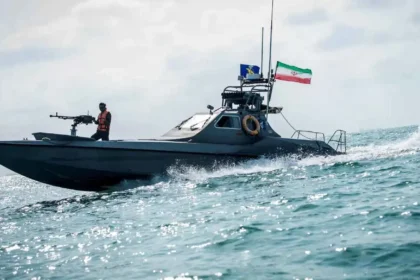
The report emphasized that despite the heavy losses suffered by Iran’s conventional naval forces in recent operations, the Islamic Revolutionary Guard Corps (IRGC) still possesses powerful capabilities and the ability to inflict disproportionate damage. According to the report, the IRGC’s current strategy relies on “mosquito fleet” tactics. This strategy involves swarming operations using fast, armed boats to launch surprise attacks on targets.
The deployment of sophisticated, hard-to-detect naval mines to disrupt the movement of large ships, and the use of suicide and reconnaissance drones to strike strategic targets and provide air cover for naval operations, confirm that the battle for the Strait of Hormuz did not end with the defeat of the regular navy. The Revolutionary Guard continues to pose an unpredictable and asymmetric threat. While the world awaits the signal from Washington to deploy the US fleet and secure navigation, the Strait remains an open battleground between conventional US military power and Iranian warfare tactics. These tactics aim to disrupt this vital global energy artery.