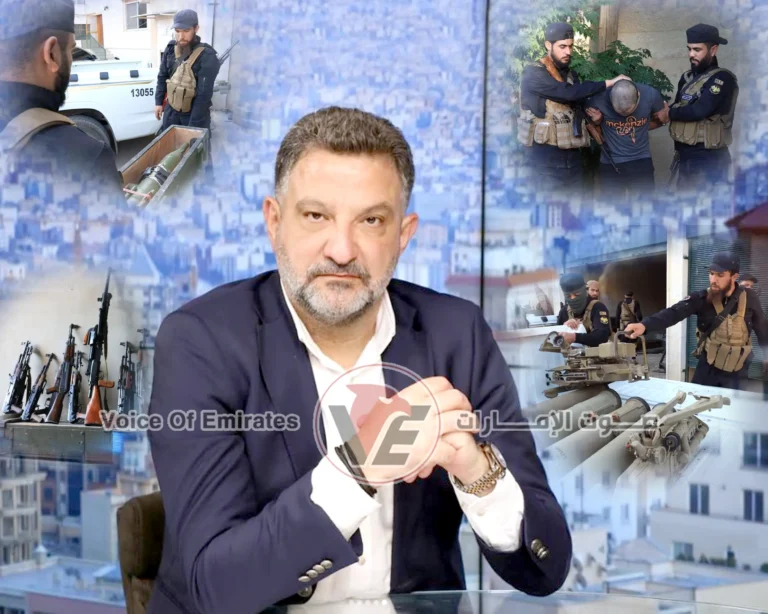
Exclusive, Voice of the Emirates – In a highly sensitive security analysis, researcher and political writer Tariq Abu Zeinab warned of the growing activities of the Lebanese Hezbollah within the Syrian arena,
stressing that field data and ongoing investigations reveal a dangerous shift in the pattern of threats;
as the party has moved from traditional confrontations to what is known as a “shadow war,”
through the planting of cluster cells that rely on civilian camouflage to implement regional agendas that transcend borders.
Camouflage strategy and “shadow warfare”
In an exclusive statement to the “Voice of the Emirates” website, Abu Zeinab explained that the plots recently thwarted
by Syrian security forces revealed a complex organizational structure within these cells.
He pointed out that these groups no longer operate as regular military formations,
but rather as small, seemingly independent cells, using civilian vehicles and non-military sites as cover
for transporting missiles and explosives, thus increasing the intelligence challenges facing the Syrian state.
Plots foiled in Quneitra and Damascus
Abu Zeinab highlighted recent operations thwarted by Damascus, most notably:
The Quneitra Cell: A “sabotage” cell was dismantled in the far south of Syria.
It was preparing to launch short-range missiles toward the occupied Golan Heights using modified civilian vehicles,
in an attempt to drag Syria into an ill-advised military confrontation with Israel.
Targeting Places of Worship: A cell was arrested in the Bab Touma area of Damascus.
It was planning to target a religious figure near a church, and weapons and explosives were seized from its possession.
The researcher revealed that the number of cells linked to Hezbollah
that Damascus announced it had dismantled has risen to four since last February,
reflecting the party’s insistence on direct involvement in managing activities that threaten Syrian internal security.
Confessions of the detainees: “The suburbs” are the starting point
Abu Zeinab indicated that the recent arrests, including those of Abdul Hamid Zanouba and Adnan Zein,
uncovered a network whose members received specialized training in Lebanon,
specifically in the southern suburbs of Beirut, on bomb-making techniques and the preparation of explosive devices.
He emphasized that the investigations proved the existence of direct meetings between these individuals
and high-ranking military and security leaders in Lebanese Hezbollah,
thus refuting the party’s repeated claims of having no organizational activity inside Syria.
Damascus’s patience is “running out”… and there are fears of embroiling the state
In his analysis of the political situation, Tariq Abu Zeinab asserted that these activities
aim to link the Syrian arena to logistical routes controlled by the Iranian Revolutionary Guard,
threatening to transform Syria into a mere conduit for the ongoing regional conflict.
Abu Zeinab concluded his statement by saying, “Judicial and security data indicate
that the Syrian authorities now possess lists of names of Hezbollah leaders involved in these networks.
Despite security coordination between Beirut and Damascus, there are strong indications
that the Syrian state’s patience is wearing thin regarding what can only be described as Hezbollah’s meddling,
which goes beyond mere support to the point of threatening the state’s very existence
and national stability, and dragging it into proxy wars.”