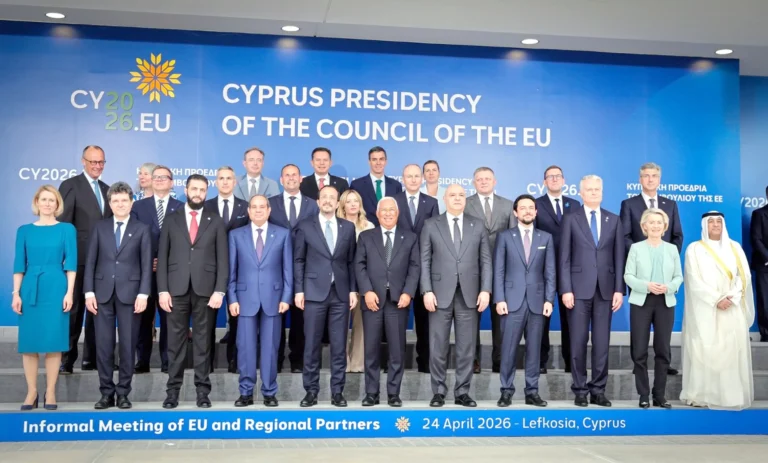
Nicosia, Cyprus – European Union leaders reaffirmed that freedom of navigation in the Strait of Hormuz is a fundamental and “non-negotiable” principle.
This came during their second day of meetings in Cyprus,
where they discussed the security and economic implications of developments in the Middle East.
Emphasis on the security of maritime routes
European officials stressed the importance of protecting international shipping lanes,
a vital artery for global trade and energy supplies, amid escalating tensions in the region.
Kaya Kallas, for her part, called for a strengthened European military presence in the region.
The aim of this call is to ensure the security of maritime routes and the safe passage of ships,
particularly in the Strait of Hormuz, one of the world’s most strategically important waterways.
Warnings regarding the nuclear agreement
Callas warned that negotiations focused solely on the nuclear issue,
without the involvement of specialized experts,
could lead to a new agreement with Iran that is less robust than the 2015 agreement.
That earlier agreement, with the participation of major international powers, restricted Iran’s nuclear program.
This European stance comes within the context of broader efforts to reassess the region’s security strategy.
These efforts are taking place amid concerns about the repercussions of
escalation on the global economy and the stability of energy supplies.