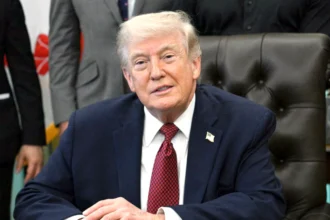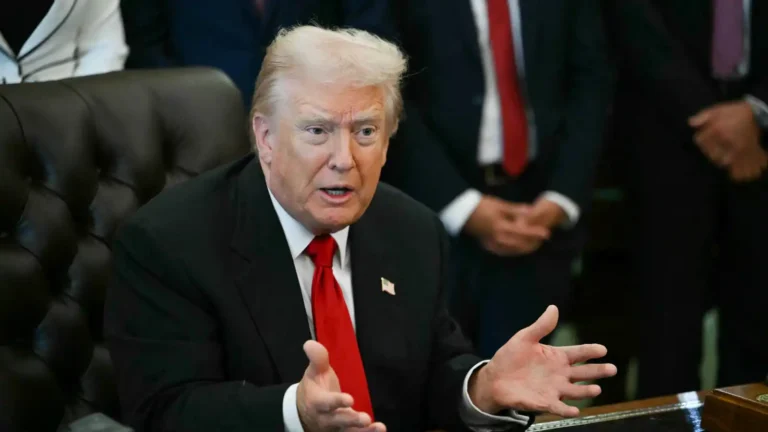
Washington, DC – In a decisive statement that further complicates the diplomatic landscape, US President Donald Trump on Friday categorically rejected any Iranian attempt to impose transit fees on ships passing through the Strait of Hormuz. He made these remarks while speaking to reporters aboard Air Force One. Trump also outlined the parameters of a “post-ceasefire” phase in a tone that carried the implication of direct military threat.
“No fees, no restrictions”
In response to reports indicating Tehran’s intention to impose “insurance or transit fees” as the Strait of Hormuz partially reopened, Trump firmly stated, “No! Absolutely not. You can’t have fees and restrictions. There will be no fees, and we will never allow them.” This stance effectively blocks Tehran’s efforts to establish a new legal reality in the international waterway. Washington considers this strait a red line for global trade.
The uranium file: Acquisition “by any means necessary”
Trump then turned to the nuclear issue, asserting that the United States would seize Iran’s stockpile of highly enriched uranium. “We’ll get it one way or another,” he said. He warned that if the ongoing talks failed, Washington would resort to “much more aggressive” measures to secure the material. However, he emphasized that the United States would eventually return the material (perhaps alluding to the dismantling of Iran’s nuclear capabilities).
Wednesday deadline: Bombs or deal
The US president revealed that a deadline of next Wednesday has been set. He explained that if a final agreement is not reached by then, the current ceasefire is “likely not to be extended.” The tightened US naval blockade of Iranian ports will continue.
He warned in an escalating tone: “In that case, the bombs will fall again.” He emphasized that his ultimate goal is to ensure that Iran never acquires nuclear weapons.
Chinese mediation and the “historic” meeting
Despite his escalating rhetoric toward Tehran, Trump expressed optimism regarding China’s role. He indicated that President Xi Jinping was “very pleased” with the opening, or imminent opening, of the Strait of Hormuz, given Beijing’s heavy reliance on energy supplies through this waterway. Trump described his upcoming meeting with the Chinese president in Beijing (expected in mid-May) as “special and possibly historic.” He also anticipated major breakthroughs during this visit, which could include a “comprehensive deal” to end the regional conflict and establish new rules for relations between Washington, Beijing, and Tehran.
Trump concluded by saying that the situation was “going very well,” but the world would have to “wait and see what happens” in the coming days.