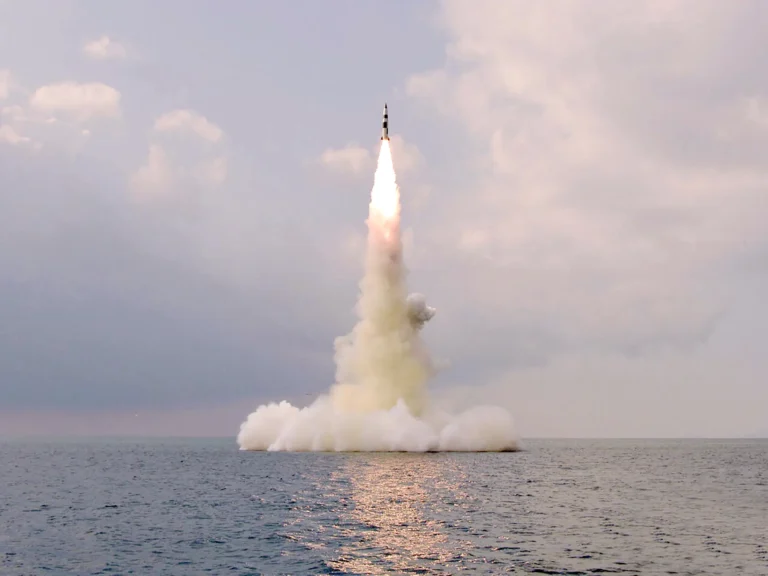
Pyongyang, North Korea – In a move described by political circles as a “multi-dimensional strategic message,” North Korea launched several ballistic missiles into the sea on Sunday.
This marks the fourth such launch this month and the seventh this year.
This escalation comes at a highly sensitive time. The launches coincide with heightened military tensions
between the United States and Israel on one side, and Iran on the other.
They also come amid reports of a possible resumption of dialogue between Pyongyang and both Washington and Seoul.
Launch details and military reactions
The South Korean military said in an official statement that the missiles were launched
from an area near the city of Sinpo on the east coast at approximately 6:10 a.m.
The missiles traveled an estimated 140 kilometers before landing in the sea.
Sinpo is of major strategic importance as it houses a submarine base
and facilities for testing submarine-launched ballistic missiles (SLBMs).
This raises questions about the type of weapons tested, especially since the last successful test of this type of missile was in May 2022.
The presidential Blue House in Seoul held an emergency security meeting,
describing the launches as a “blatant provocation that violates UN Security Council resolutions.”
It called on North Korea to immediately cease actions that destabilize the region.
In Tokyo, the Japanese government confirmed that the missiles landed outside its exclusive economic zone.
It also emphasized that it was closely monitoring the situation.
Timing implications: Iran and preemptive pressure
Experts believe this intensified activity is not merely technical testing, but a preemptive “show of force.”
In this context, Kim Ki-joong, a former South Korea presidential security advisor,
stated, “These operations may be a way to demonstrate that Pyongyang-unlike Iran-possesses decisive self-defense capabilities,”
suggesting that the North is exerting pressure to bolster its leverage before entering any future negotiations.
There are also concerns that the ongoing conflict in West Asia against Iran,
ostensibly aimed at curbing Tehran’s nuclear ambitions,
could push North Korean leader Kim Jong-un to accelerate his nuclear program as a “defensive shield.”
This possibility is heightened by his recent declaration that his country’s status as a nuclear power is “irreversible.”
Prospects for dialogue in light of nuclear challenges
Despite the escalation, diplomatic channels remain open, with US President Donald Trump preparing for a summit in China next month.
South Korea President Lee Jae-myung has also expressed a willingness to engage in talks.
However, international warnings persist. The head of the International Atomic Energy Agency,
Rafael Grossi, has cautioned against “very dangerous” advances in Pyongyang’s nuclear capabilities.
This makes any future dialogue fraught with complex issues and stringent security requirements.