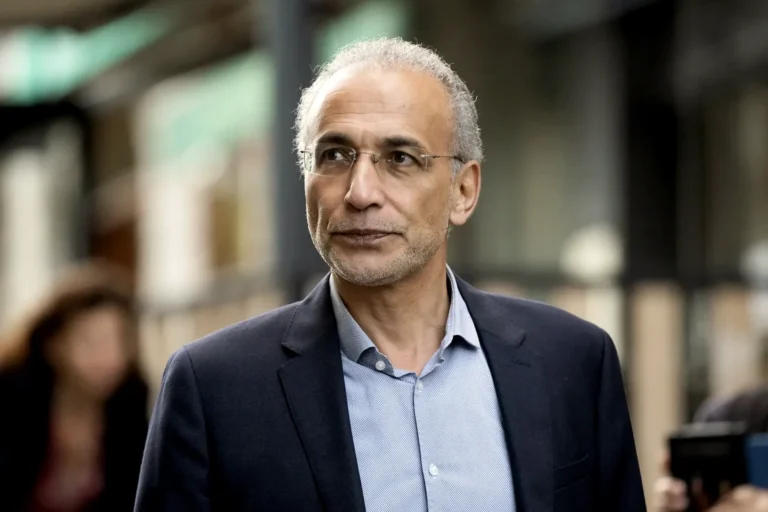
Paris, France – In a scene that encapsulates a complex and turbulent legal process spanning more than eight years, Swiss scholar Tariq Ramadan, grandson of Muslim Brotherhood founder Hassan al-Banna, will appear before the Paris Criminal Court from March 2nd to 27th.
This trial brings to a close years of legal and media anticipation in a case that has shaken the foundations of Europe’s intellectual and religious elite.
Charges of “explicit violence” and a possible sentence of up to 20 years
Ramadan, 63, faces serious charges of raping three women in France between 2009 and 2016. According to legal reports, a conviction could lead to a sentence of up to 20 years in prison, the maximum penalty for such crimes under French law.
The case dates back to 2017 when activist Henda Ayari ignited the scandal by filing the first official complaint, followed by complaints from “Christelle” (a pseudonym) and a third woman. Despite his initial denials, Ramadan backtracked in mid-2018, admitting to extramarital affairs, describing them as “dominant relationships” consensual—a claim the accusers vehemently deny.
Shocking details and requests for secret sessions
The investigating judges, in their referral decision, noted harrowing testimonies from the victims, describing the “physical coercion and outright violence” they endured, including “restriction of movement, the use of physical force to subdue them, and the issuing of humiliating orders.”
In a move to ensure the protection of the plaintiffs, the lawyers representing the victim “Christelle” announced that their client would request that the hearings be held in camera to avoid the pressure and harassment she faced during the investigation, especially since the accused had publicly revealed her identity on previous occasions.
The victims’ defense team emphasized that this trial represents a “long-awaited and crucial moment” more than 16 years after some of the alleged incidents.
Ramadan’s defense: “Nervous rigidity” and procedural maneuvers
Meanwhile, Tariq Ramadan’s defense team continued to file appeals and employ legal maneuvers to obstruct the criminal proceedings. His lawyers argued that their client suffers from multiple sclerosis, claiming that his health condition does not permit him to appear in court without endangering his life. The defense also criticized what they described as the judiciary’s insistence on proceeding with the trial, arguing that this does not guarantee a fair trial, given the disregard for their requests to add new evidence to the case file.
Cross-border prosecutions and a pivotal appeal decision
Tariq Ramadan’s troubles don’t end at the French border. In Switzerland, an appeals court sentenced him in September 2024 to three years in prison (one year suspended) for the 2008 rape of a woman in Geneva. A notable aspect of the French case was the appeals court’s decision to drop the concept of “psychological control,” which had characterized the initial stages of the investigation. The court ruled that this concept alone could not be relied upon to prove deprivation of free will. Instead, the court focused on proving the “explicit physical violence” that the victims unanimously described in detail.
As the French judiciary prepares to open this thorny case, Tariq Ramadan finds himself alone before the bench, facing not only his acquittal or conviction, but also a confrontation with an “intellectual and symbolic legacy” that has crumbled under the weight of serious criminal charges. Will the March hearings be the final word in the story of the “intellectual authority” who has become a “criminal defendant”? The international public awaits the answer.