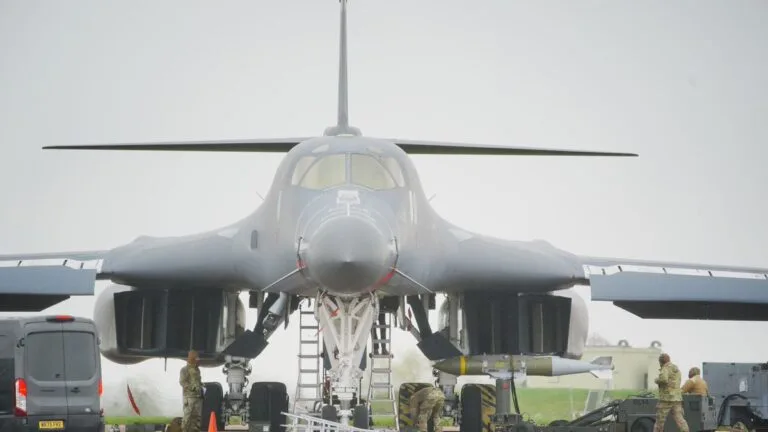
Washington, United States – In a prominent field development that reflects the escalation in the intensity of the military confrontations that have been ongoing for twelve days, American officials revealed that the American army used a long-range B-1 bomber for the first time in the strikes it launched on targets inside Iran on Tuesday. The Axios news network indicated that the deployment of these strategic bombers represents a milestone and a clear indication of expanding the scope of the American military campaign and raising its destructive level. This is due to the unique ability of these aircraft to carry approximately 24 bombs, each weighing two thousand pounds (about 900 kilograms). In addition, it also has the ability to load dozens of cruise missiles.
The B-1 bomber is distinguished by its superior ability to fly at supersonic speeds at extremely low altitudes, surpassing any other bomber in size and weapons payload capacity. The bomber took off for its combat mission from a major airbase in the United Kingdom. Its flight path was subsequently tracked by websites specializing in global flight tracking. Despite the significance of this deployment, the US Central Command (CENTCOM) made no mention of the B-1’s mission in its official statement on Tuesday regarding the strikes.
Strike targets and field mobilization status
In its statements, Central Command explained that the military operations specifically targeted “Iranian military operations centers, naval capabilities, aircraft hangars, drone storage facilities, and military logistics infrastructure.” The primary objective was to undermine Tehran’s ability to threaten vital shipping lanes and commercial traffic in the Strait of Hormuz. Despite the scale of these strikes, no precise details were released regarding the specific targets destroyed by B-1 bombers or the extent of their actual superiority compared to previous missions.
In light of this ongoing escalation and the continued heavy US military buildup in the Middle East region, reports from American and Israeli officials indicate that US President Donald Trump is still seriously considering the option of returning to large-scale combat operations against Iran. These operations are likely to occur within days. It is noteworthy that the United States had carried out previous missions with B-1 bombers during Operation Epic Fury, targeting missile bases, command centers, and air defenses.
Assessing Iranian capabilities and Trump’s presidential threats
On the ground, US defense officials offered differing assessments of the strikes’ effectiveness in neutralizing Iranian threats. Some officials believe Iran’s military capabilities around the Strait of Hormuz have been “virtually eliminated,” while others maintain that Tehran retains the ability to launch attacks against commercial vessels in the region. Meanwhile, President Trump issued strongly worded threats on Wednesday, vowing to bomb bridges and vital power plants, including sites within the Iranian capital, Tehran, should Iran attack further commercial ships in the strategic strait.
Behind the scenes of diplomatic mediation and the stalled agreement
On the diplomatic front, intensive regional efforts to contain the crisis continue. US officials reported that Qatari mediators are holding intensive talks with American, Iranian, and Omani parties to reach a new settlement that would ensure the reopening of the Strait of Hormuz and a ceasefire. However, a well-informed regional source indicated that the Iranian leadership has not yet accepted the latest proposal presented by the mediators. Consequently, uncertainty remains regarding the timeframe Trump will allow for these diplomatic efforts.
In a speech he delivered Wednesday evening in Georgia, President Trump commented on the course of the negotiations, saying: “They are being hit very hard, and they want to make a deal,” adding at the same time: “But I say they are not ready to make a deal, because every time they make a deal they want to change it and everything else. They are not ready. They will be ready very soon.”