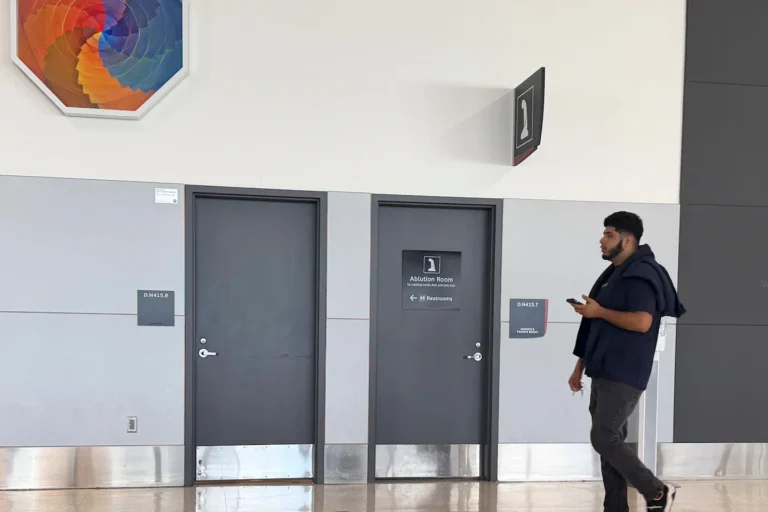
Texas, United States — Texas Governor Greg Abbott has ignited a fresh political and legal debate over religious freedom and non-discrimination after ordering a state review of ablution (wudu) facilities in public airports. Consequently, the directive has raised intense scrutiny over whether accommodating Muslim travelers constitutes standard customer service or an impermissible preference under state law. Furthermore, the controversy underscores deepening divisions over the boundaries of religious accommodations within government-funded infrastructure.
Reviews at Dallas and Houston Airports and Local Defense
The state inquiry centers on Dallas/Fort Worth International Airport and George Bush Intercontinental Airport in Houston, both of which feature or planned dedicated ablution stations. Additionally, local authorities in Houston defended the installations, emphasizing that catering to a diverse global travel base does not amount to special treatment. Consequently, airport management maintains that such amenities merely address the practical needs of passengers and staff from varied cultural backgrounds.
Civil Rights Opposition and Arguments for Neutrality
Abbott’s directive sparked swift criticism from human rights and Muslim advocacy groups, who warned that politicizing wudu facilities risks fostering anti-Muslim stigma and curtailing religious expression. Additionally, supporters of the governor contend that public funds and state property must adhere strictly to uniform standards to avoid any appearance of religious bias.
Finally, what began as a dispute over airport amenities has transformed into a broader conflict over religious accommodations in public spaces. Ultimately, the resolution will depend on how legal scholars and state regulators interpret public neutrality laws against traveler accommodation principles.