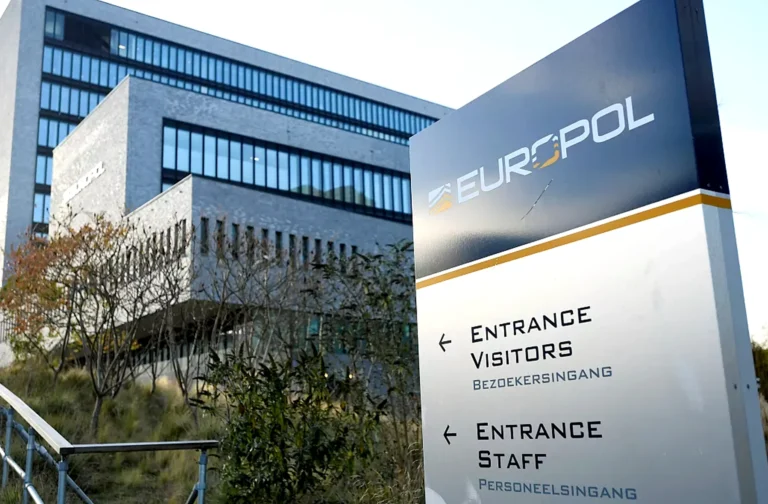
Brussels, Belgium – Europol, the European Union’s law enforcement agency, has confirmed that the most threatening criminal networks in the EU continue to adapt to security pressures.
They also exploit digital, financial, and geopolitical vulnerabilities.
Despite this, law enforcement agencies have achieved successes in dismantling a significant number of these networks.
Dismantling some networks and the emergence of others
Europol, in its new report titled “Decoding the EU’s Most Threatening Criminal Networks: Part 2 – The Criminal Opportunism Scheme,”
revealed that 76% of the criminal networks identified in 2024 were either dismantled or no longer classified as among the most dangerous.
This reflects the effectiveness of security operations based on intelligence and precise targeting.
Conversely, the report indicated that 198 criminal networks remained active.
In addition, 533 new networks emerged, reflecting the evolving nature of organized crime and its ability to rapidly reconstitute itself.
Utilizing modern technology
The report noted that criminal networks do not operate in isolation, but rather within an interconnected system
that provides them with significant flexibility in cooperation and adaptation.
They also utilize encrypted communication methods, artificial intelligence technologies,
cryptocurrencies, and money laundering techniques to conceal their activities.
These methods are also used to reinvest their illicit proceeds.
Europol’s Acting Executive Director, Jürgen Eber, emphasized that dismantling any network weakens the criminal system.
However, criminal organizations continue to rapidly fill the gaps.
Therefore, enhanced intelligence and operational cooperation between countries is essential.
Calls to strengthen European cooperation
For his part, EU Commissioner for Migration and Home Affairs, Magnus Brunner,
stressed that understanding the workings of criminal networks is the first step in combating them.
He also emphasized that tackling organized crime requires common European solutions, given its transnational nature.
Europol called for expanded cooperation between law enforcement agencies, public authorities, and the private sector.
At the same time, it recommended adopting innovative tools and a comprehensive approach
to reduce the threats of organized crime and enhance the security of EU citizens and institutions.