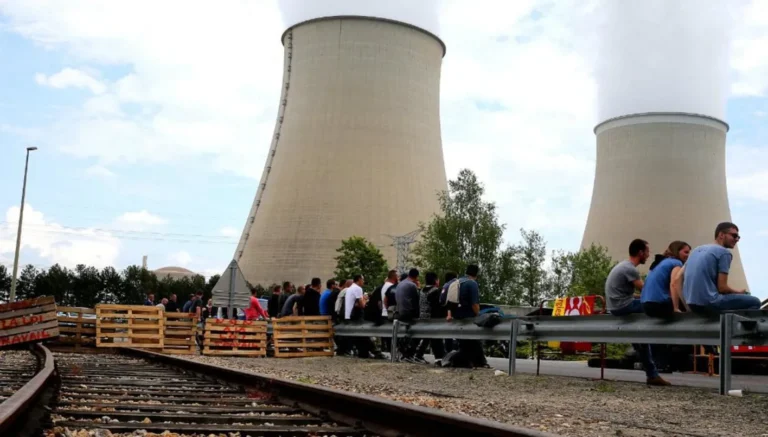
Paris, France – The French energy management company EDF announced the suspension of operations at the Golfeich nuclear power plant, located in the Tarn-et-Garonne department of southwestern France, as a precautionary measure due to the extreme heatwave gripping the country. This comes as the French meteorological service recorded record-breaking temperatures, which are expected to exceed 40 degrees Celsius across much of the country. This coincides with more than 20 deaths linked to the extreme weather.
Environmental standards and the cooling crisis
France’s 57 nuclear reactors rely primarily on cooling systems that draw their water from rivers or the sea. Strict environmental regulations, particularly a 2006 decree, impose precise limits on the temperature of river water discharged from the plants. It must not exceed 28 degrees Celsius to ensure the protection of the ecological balance of aquatic flora and fauna. Because the water temperature of the Garonne River, which feeds the Golfeche plant, had reached this level, the company was forced to shut down one of its operating reactors. Meanwhile, the other reactor was already offline for maintenance.
Station capabilities and production challenges
The Golfeich power plant, near Toulouse, contains two pressurized water reactors, each with a capacity of 1.3 gigawatts. While shutting down plants for environmental reasons was previously a limited measure, with annual energy production reductions of only about 0.3%, the effects of climate change are beginning to create a new reality.
The future of nuclear energy in the context of climate change
It is estimated that if this climatic pattern continues without technological adaptation, the average annual decline in production could reach 1.4% by 2035 and 1.5% by 2050. With the heatwave persisting, EDF faces increasing logistical challenges. The possibility of having to reduce production at other nuclear power plants nationwide also looms, raising questions about the resilience of France’s nuclear energy infrastructure to extreme weather events.
This crisis is a direct reflection of the pressures that global warming is placing on vital sectors. France’s energy security is no longer immune to the impact of rising global temperatures on aquatic ecosystems.