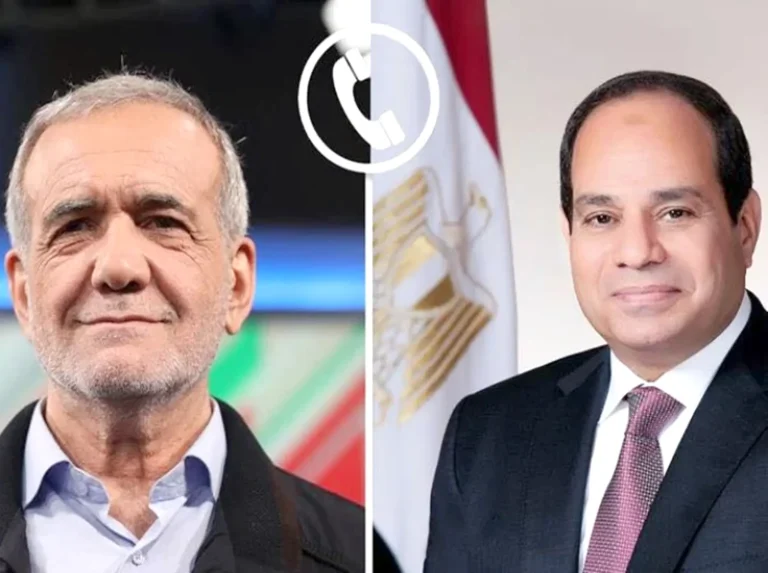
Cairo, Egypt – Egyptian President Abdel Fattah al-Sisi stressed the importance of avoiding escalation in the region and allowing the ongoing negotiations between the United States and Iran to proceed.
This came during a phone call he received from Iranian President Masoud Pezeshkian.
During the call, the two presidents discussed regional developments and efforts to reach political
understandings that would contribute to reducing tensions and restoring stability to the region.
Egyptian support for the negotiation process
The Egyptian presidential spokesperson explained that the call addressed the ongoing negotiations
between Washington and Tehran and Egypt’s role in bridging the gap between the various parties.
During the call, President Sisi emphasized Egypt’s full support for the US-Iranian negotiations.
He also stressed the importance of continuing political and diplomatic efforts to reach
a comprehensive agreement that would end the current escalation.
Furthermore, the Egyptian president reviewed Cairo’s ongoing communications with several regional and international parties.
These communications aim to facilitate dialogue and pave the way for a comprehensive political settlement.
Rejecting aggression against Gulf states
President El-Sisi affirmed Egypt’s position rejecting any aggression against the sovereignty of the Gulf states or any threat to their territorial integrity.
He also stressed that Gulf security is a fundamental component of Arab national security.
He called for political flexibility and urged the avoidance of miscalculations that could escalate tensions and instability in the region.
For his part, Iranian President Masoud Pezeshkian reviewed the progress of the ongoing negotiations.
He also expressed his appreciation for the efforts exerted by Egypt and several regional countries to bridge the gap between Iran and the United States.
Furthermore, he emphasized his country’s commitment to strengthening relations with Arab states,
particularly the Gulf Cooperation Council (GCC) countries, within the framework of respecting
the principles of good neighborliness and the peaceful settlement of disputes.