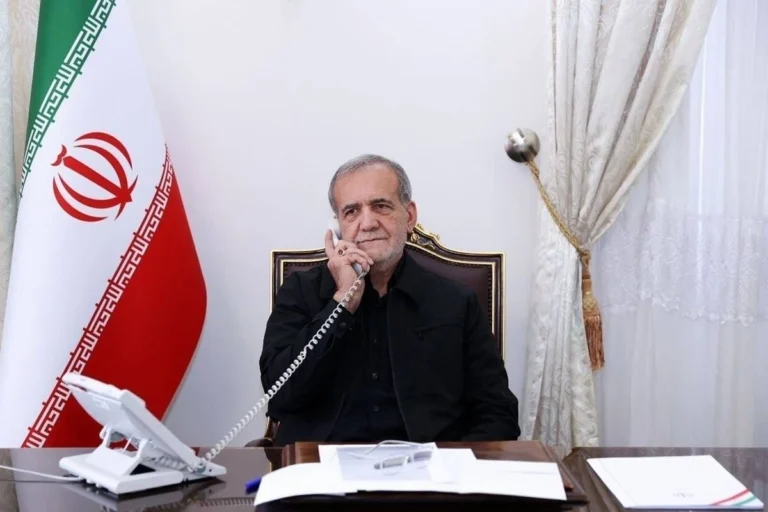
Tehran, Iran – In a move aimed at harmonizing and unifying Iran’s political discourse before the world, Iranian President Masoud Pezeshkian, during a meeting with the heads of the state broadcasting organization, emphasized that no strategic decision in the country is made independently of the highest institutions.
Pezeshkian stressed that “no decision is made outside the framework of the Supreme National Security Council, and without the coordination and approval of Iranian Supreme Leader Mojtaba Khamenei.”
Pezeshkian added that Iranian diplomacy must present a unified voice to the international community. He also called on all institutions, platforms, and movements to support the decisions issued by the Supreme National Security Council to ensure consistency in the national position.
Initial understandings with Washington
The Iranian president’s remarks come amid reports of a potential agreement with the United States.
A senior Iranian source confirmed to Reuters that any memorandum of understanding reached would be immediately submitted to Supreme Leader Mojtaba Khamenei for final approval before it could take effect.
In a related development, the Tasnim news agency, affiliated with Iran’s Revolutionary Guard, revealed details of the “potential” preliminary understandings. It indicated that Tehran remains firm in its position of not making any concessions on the nuclear issue.
According to the report, the terms of the understanding include a US commitment to suspend oil sanctions. This would allow Tehran to sell its oil without restrictions.
Key features of the agreement: ending the war and opening the strait
According to Tasnim, the draft agreement includes crucial clauses concerning the regional situation, stating that its announcement would lead to “an end to the war on all fronts, including Lebanon.” Furthermore, the agreement includes an Israeli commitment to end its military operations there.
On the implementation front, the understandings established a precise timetable. A 30-day period was set for implementing the measures to lift the naval blockade and reopen the Strait of Hormuz. This would be followed by a 60-day period dedicated to in-depth negotiations regarding the Iranian nuclear program.
This diplomatic move comes at a pivotal moment, as Tehran seeks to counterbalance economic pressures with diplomatic channels. However, it has been emphasized that the final decision rests with the supreme leadership, ensuring a unified stance in the face of any future international developments.