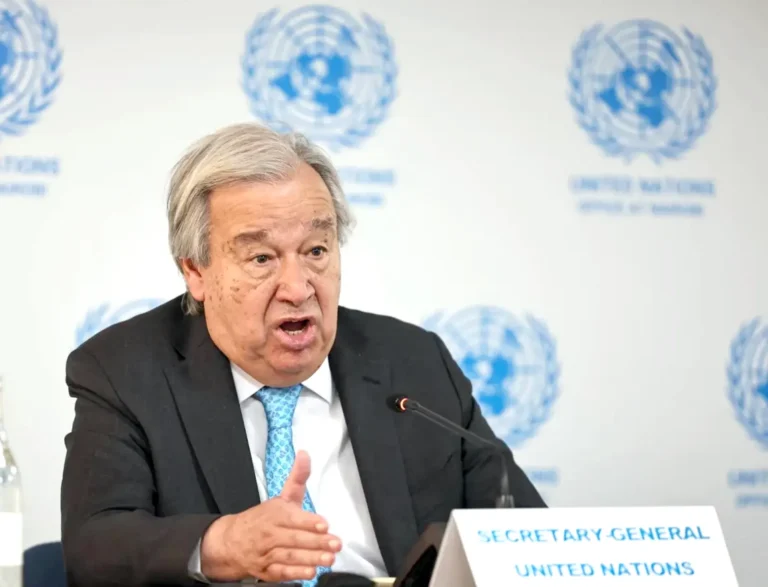
Nairobi, Kenya – UN Secretary-General António Guterres called for reform of the international system and greater representation for African countries in global governance institutions.
He also stressed that the continent is a cornerstone of the future of multilateralism.
This came during the inauguration of new buildings at the UN compound in Nairobi
and the laying of the foundation stone for a new conference center,
in the presence of Kenyan President William Ruto and a number of senior officials and diplomats.
Major expansion of the United Nations headquarters in Africa
Guterres praised Kenya’s support for the United Nations, emphasizing that the Nairobi campus is
the only UN headquarters in Africa and the Global South.
It also serves as a pivotal hub for the organization’s work in the areas of environment, development, and refugees.
He noted that the new expansion enhances the UN’s ability to operate more efficiently.
This comes as several international agencies relocate to the campus, including UNHCR, UNICEF, and UN Women.
He explained that the new buildings are the first “zero-emission” UN facilities in Nairobi, relying entirely on solar power.
Furthermore, there are plans to achieve complete energy neutrality by 2030.
A call for reform of the global financial system
He also unveiled a project to rehabilitate forests in the Jigiri region and plant thousands of trees.
In addition, there is a plan to design facilities that are accessible to people with disabilities,
as part of an expansion project valued at approximately $340 million.
Guterres criticized the current international system, arguing that it does not reflect modern global balances.
He pointed out that Africa suffers from a heavy debt burden
and higher borrowing costs compared to developed countries.
He called for reform of the Security Council and the Bretton Woods institutions.
He also demanded greater representation for Africa to ensure its participation in global decision-making,
emphasizing that international justice cannot be achieved without it.
Africa: Between Historical Legacy and Future Aspirations
The Secretary-General noted that the African continent has historically suffered from colonialism and exploitation.
However, today it is witnessing a growing movement, led by its youth, towards development, innovation, and a stronger international standing.
Guterres emphasized that the United Nations is reassessing its working methods as it approaches its 80th anniversary.
This comes amidst increasing recognition of Africa’s role as a source of solutions in issues of peace, development, and human rights.
The expanded UN complex in Nairobi is expected to become one of the organization’s largest centers globally,
with a capacity of approximately 9,000 participants.
It will also host major international meetings in the coming years,
further solidifying Kenya’s position as a leading global diplomatic hub on the African continent.