Beirut, Lebanon – The Lebanese arena witnessed its most intense military escalation in weeks, as the Israeli army expanded its air and ground operations. It announced carrying out more than 85 airstrikes in the past 24 hours.
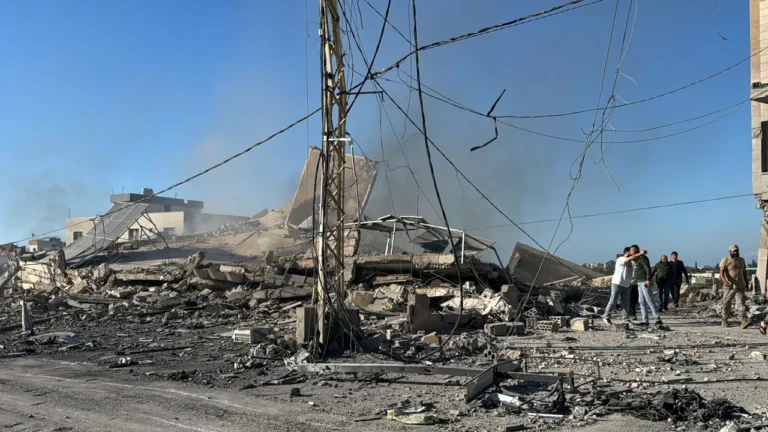
This intensified wave of attacks targeted what the Israeli army described as Hezbollah’s “military infrastructure.” The operations spanned villages in southern Lebanon and extended deep into the Bekaa Valley in the east of the country.
Targeting underground facilities and launch pads
In detailing the field operations, Israeli military spokesman Avichai Adraee reported that the airstrikes targeted weapons depots, missile launch sites, and buildings used by Hezbollah operatives for operational purposes.
Adraee revealed a targeted raid on an underground site in the Bekaa Valley. He claimed it was used to produce advanced weaponry aimed at targets deep inside Israel and forces operating on the border. The spokesman confirmed that the Israeli army successfully eliminated Hezbollah operatives who were planning “terrorist attacks” against ground forces in the south. He also emphasized that the operations would continue until all “threats” are eliminated and the northern border is fully secured.
Hezbollah’s response and a bloody toll
This Israeli escalation came a day after Hezbollah announced it had carried out extensive attacks using drones and advanced missiles, targeting military bases in northern Israel, including the Shragah base near Nahariya and a strategic airbase.
The party confirmed that these operations were in retaliation for the assassinations and strikes that targeted the southern suburbs of Beirut.
On the ground, the airstrikes had a devastating impact on civilians. The Lebanese Ministry of Health announced on Friday that 10 people, including two children and three women, were killed in the bombing of southern Lebanon.
The ministry also documented an airstrike that targeted an ambulance team in the town of Majdal Selm. This attack resulted in the death of one paramedic and injuries to another, an attack the Israeli army justified by claiming it targeted a “terrorist operating under the guise of a paramedic.”
Evacuation warnings and a faltering political process
In parallel with the bombardment, the Israeli army issued urgent evacuation warnings to residents of several southern villages and towns, triggering a new wave of displacement amid dire humanitarian conditions. Despite the sounds of artillery fire, a glimmer of diplomatic hope appears on the horizon, as Lebanon prepares to participate in a crucial round of negotiations with Israel in Washington on May 14.
According to Lebanese Foreign Minister Youssef Raji, these talks aim to solidify the ceasefire and discuss the withdrawal of Israeli forces from the occupied territories.
For his part, Lebanese President Joseph Aoun issued strict directives to the Lebanese negotiating delegation, emphasizing the need to protect national sovereignty. The world is watching to see if diplomacy will succeed in curbing the war machine before the situation escalates into a full-blown regional confrontation.