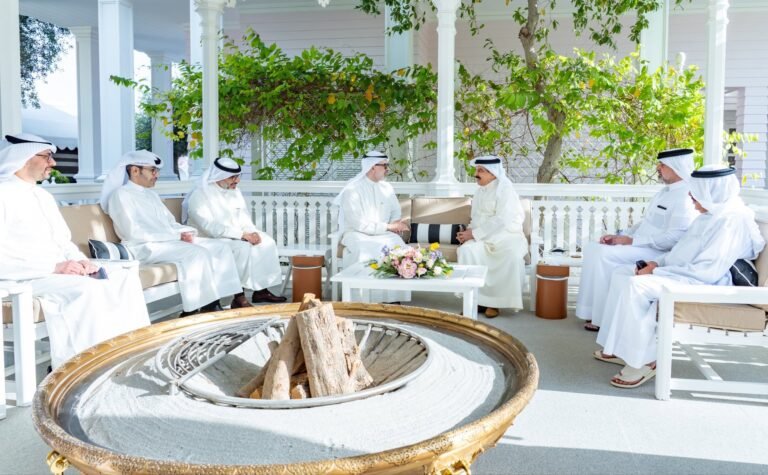
Manama – King Hamad bin Isa Al Khalifa of the Kingdom of Bahrain received Jarrah Jaber Al-Ahmad Al-Sabah, the Minister of Foreign Affairs of the State of Kuwait, and his accompanying delegation at Sakhir Palace. During the meeting, the current and sensitive conditions in the region were reviewed, in addition to the most prominent regional and international developments. Furthermore, the two sides discussed issues of common interest that bind the two brotherly countries with close historical ties. Accordingly, joint Gulf coordination represents a safety valve for facing escalating crises and securing the future of nations. In this regard, the King of Bahrain emphasized the depth of the fraternal relations that bring Manama and Kuwait together in all fields.
Discussing Regional Developments and Intensifying Efforts for Security and Stability
The meeting addressed the diligent and current efforts to deal with the complex regional challenges facing the countries of the region. Obviously, the King and the Kuwaiti Foreign Minister stressed the importance of intensifying consultation between brotherly countries to effectively face rapid developments. As a result, the two countries seek to build a unified position that contributes directly to supporting the pillars of regional security and stability. In addition, joint Gulf coordination enhances the countries’ ability for diplomatic maneuvering amidst current international conflicts. However, there remains an urgent need for continued bilateral meetings to ensure harmony of political visions regarding thorny files.
Strengthening Diplomatic Cooperation in the Security Council and International Forums
Bahraini Foreign Minister Abdullatif bin Rashid Al Zayani discussed with his Kuwaiti counterpart ways to develop political and diplomatic coordination in major international forums. Certainly, the talks focused on investing in Bahrain’s non-permanent membership in the Security Council to serve Arab and Gulf issues. Accordingly, these moves aim to unify diplomatic discourse to serve the supreme strategic interests of the two countries. On the other hand, joint Gulf coordination contributes to clearly delivering the region’s voice to the international community and global decision-makers. In the same context, cooperation in international organizations represents a means to enhance the political and economic influence of GCC countries.
Unity of Ranks in Facing Iranian Aggressions and Securing Energy Supplies
he two sides discussed the efforts of the Cooperation Council for the Arab States of the Gulf in unifying positions to face security challenges, including the repercussions of recent Iranian aggressions. Obviously, these aggressions directly affected the region’s security, global economic stability, and international trade movement. As a result, the two countries emphasized the necessity of protecting global energy supplies and securing vital waterways against any external threats. In addition, joint Gulf coordination remains the fundamental pillar for protecting the interests of the Council countries and maintaining their national sovereignty. Ultimately, Gulf unity of ranks will remain the protective shield that guarantees the sustainability of growth and prosperity in the face of all regional ambitions.