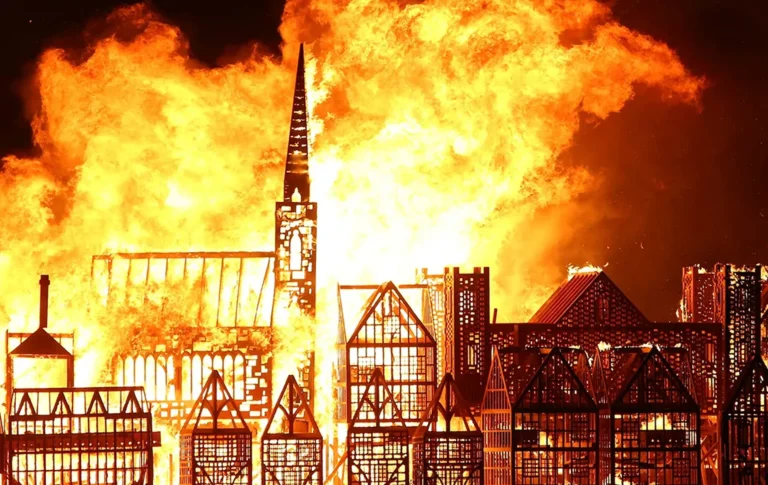
London, England – In September 1666, large parts of the British capital were engulfed in flames.
This occurred after what later became known as the Great Fire of London, one of the most infamous disasters in the city’s history.
The fire began in the early morning of September 2, 1666, in a bakery on Pudding Lane.
The densely packed timber-framed buildings and strong winds
then helped it spread rapidly through the city’s neighborhoods.
Extensive damage to shops and public facilities
In the following hours, the fire spiraled out of control, spreading from one area to another.
Meanwhile, residents and authorities attempted to combat the disaster
using the limited firefighting equipment available at the time,
which was far more advanced than what is available today.
The fire raged for several days, consuming vast areas of London.
It destroyed thousands of homes, buildings, and other structures,
and caused extensive damage to churches, shops, and public facilities.
The fires destroyed more than 13,000 homes
Historical estimates indicate that the fires destroyed more than 13,000 homes
and approximately 87 churches, including the ancient St. Paul’s Cathedral.
Tens of thousands of residents were forced to flee their homes and seek
refuge in safer areas outside the burning zones.
Despite the scale of the devastation, the officially recorded death toll
remains remarkably low compared to the magnitude of the disaster.
However, some historians suggest that the true number was likely much higher
than the figures that have come down to us,
especially since the recording of deaths among the poor and disadvantaged was not always accurate at the time.
London Reconstruction Phase
After the fires subsided, the rebuilding of London began.
The disaster was used as an opportunity to reorganize parts of the city,
encouraging the use of more fire-resistant building materials.
Some streets were widened, and the city’s layout was improved.
Thus, the Great Fire of London was not merely a catastrophe that left thousands of buildings in ruins.
It became a turning point in the city’s history, contributing to the shaping of modern London
and the rebuilding of the heart of the British capital.