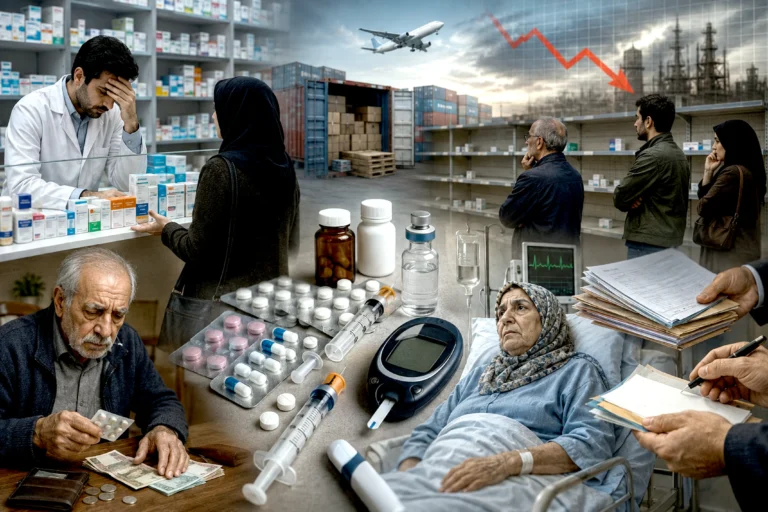
Tehran, Iran – Iran’s healthcare system is facing a deepening structural crisis that threatens catastrophic consequences for the country’s access to medicine. Local reports, citing pharmaceutical industry officials, warn that drug prices could triple.
This comes as the pharmaceutical market enters a critical emergency phase
due to severe shortages of essential medications and disruptions to supply chains.
Supply chain disruptions and shortages of hundreds of vital items
Reports published by Rouydad24 revealed statements describing the pharmaceutical situation in the country as “extremely alarming.”
The data indicated that approximately 800 types of pharmaceutical
products are currently facing significant shortages, including dozens of vital, life-saving medications.
This crisis stems from a complex interplay of problems, including a shortage of foreign currency, obstacles to international bank transfers,
and the accumulation of unpaid insurance debts, in addition to ongoing import disruptions.
Hadi Ahmadi, spokesperson for the Iranian Pharmacists Association,
pointed out that the inability of local factories to secure raw materials has severely hampered production,
while traditional import channels have ceased.
He noted that resorting to alternative import and procurement methods to meet the needs will be time-consuming.
Although the Food and Drug Administration announced its reliance on
these alternatives to overcome the difficult transportation conditions,
this will incur exorbitant costs that will directly impact the final prices of medications, potentially tripling them.
The illusion of self-sufficiency and the danger of dependence on foreign entities
Official figures reveal a discrepancy between production volume and monetary value.
While local factories cover approximately 99% of market demand in terms of manufactured pharmaceuticals,
imported drugs represent only 13.86% of the total market value.
This demonstrates that the local pharmaceutical industry remains
dependent on imported raw materials and specialized equipment.
Consequently, any disruption in currency transfers or material shipments is immediately
followed by a shutdown of local production lines.
The disastrous results then appear on pharmacy shelves.
Patients suffering and the monster of the black market
This crisis is casting a heavy shadow on the most vulnerable segments of society,
such as those with chronic illnesses, the elderly,
and those with specific conditions who rely on expensive, imported medications.
Numerous testimonies received by human rights and media platforms like IranWire from citizens suffering immensely
confirm that the inability to afford medication has completely disrupted their treatment plans.
This has pushed a large segment of the population towards alternative options,
such as traditional medicine, or even to discontinue treatment altogether.
Furthermore, the report warned of the growing phenomenon of
a “black market” for rare medications at exorbitant prices.
Observers emphasized that this informal market poses a threat comparable to price inflation,
given the lack of oversight and the impossibility of verifying the authenticity of products and their storage conditions.
With supplementary insurance plans unable to cover these enormous cost differences
amidst the general economic crisis, patients are left to face an unprecedented financial burden that threatens public health.