
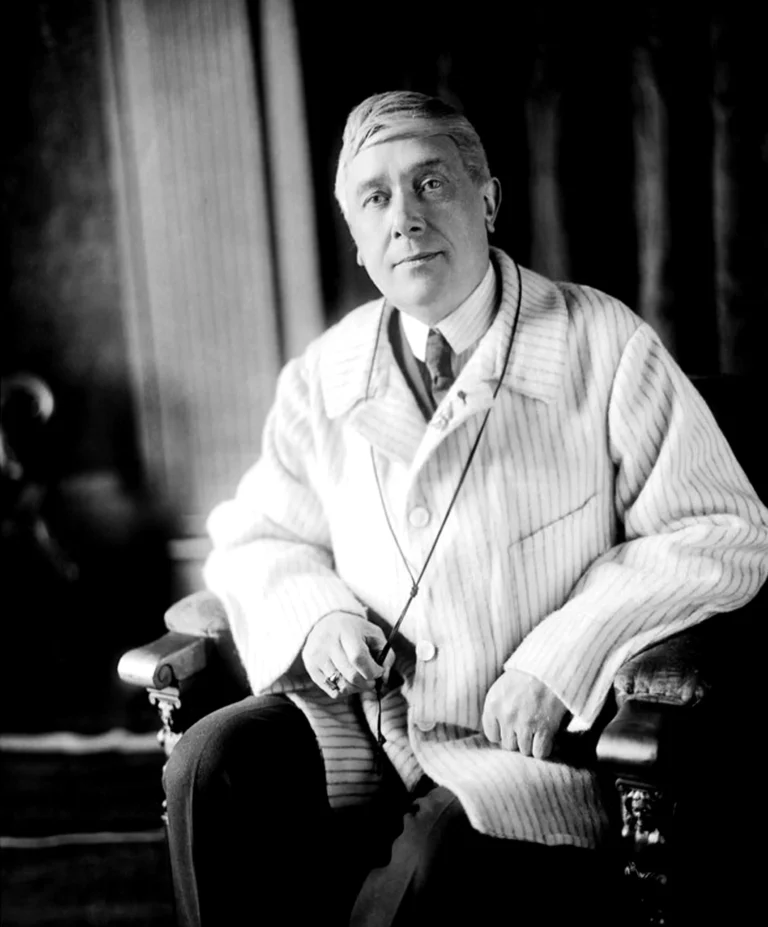
Ghent, Belgium – Belgian writer Maurice Maeterlinck could never have imagined that his legal studies would lead him to become one of the most celebrated figures in European literature.
Abandoning a conventional career path, he turned to writing.
He later became a leading figure in the Symbolist movement and was awarded the Nobel Prize in Literature.
Born in Ghent, Belgium, in 1862 to a well-to-do family, Maeterlinck received a legal education before embarking on a career in law.
However, his passion for literature and philosophy proved stronger than his desire to pursue a legal career.
Ultimately, he chose to dedicate his life to writing and creative expression.
Works that focused on humanity and its fears
The Belgian writer Maurice Maeterlinck’s literary career began in the 1880s, and he quickly attracted attention
with a style distinct from the prevailing literary trends of the time.
He joined the Symbolist movement, which relied on suggestion, symbolism,
and psychological and philosophical reflections to express profound ideas and feelings.
Theater was one of Maeterlinck most prominent fields, where he presented works that focused on humanity,
its fears, its destiny, and its relationship with death and the unknown.
Among the works that helped solidify his fame was the play “Princess Malene.”
His subsequent works further cemented his literary standing.
Then came “The Blue Bird,” which became one of his most famous works.
In it, he presented an allegorical tale about the search for happiness.
Over time, the story became well-known beyond European literary circles.
Global recognition of Maeterlinck’s talent
Maeterlinck creativity wasn’t limited to the theater. He also wrote poetry, essays, and philosophical works.
His writings grappled with profound questions about life, death, love, loneliness, and destiny.
He sought to uncover the hidden meanings behind the human experience.
In 1911, Maeterlinck reached the pinnacle of international recognition when he was awarded the Nobel Prize in Literature.
This prize was a testament to his imaginative, symbolic, and intellectually profound literary output.
Advanced stages of Maeterlinck’s life
The Belgian writer continued writing well into his later years, remaining a prominent figure in the European cultural scene through his plays and intellectual works.
These works influenced numerous writers and artists throughout the 20th century.
Maeterlinck spent his final years in France, dying in 1949 at the age of 86.
He left behind a literary legacy that inextricably linked his name to symbolic theater and European literary thought.
The unique aspect of his experience lies in the fact that he not only changed his profession but also completely rebuilt his life around literature.
After initially studying law, he chose writing, finding in it the path that brought him international acclaim.
He ultimately received the Nobel Prize as one of the most prominent literary voices in Belgium and Europe.