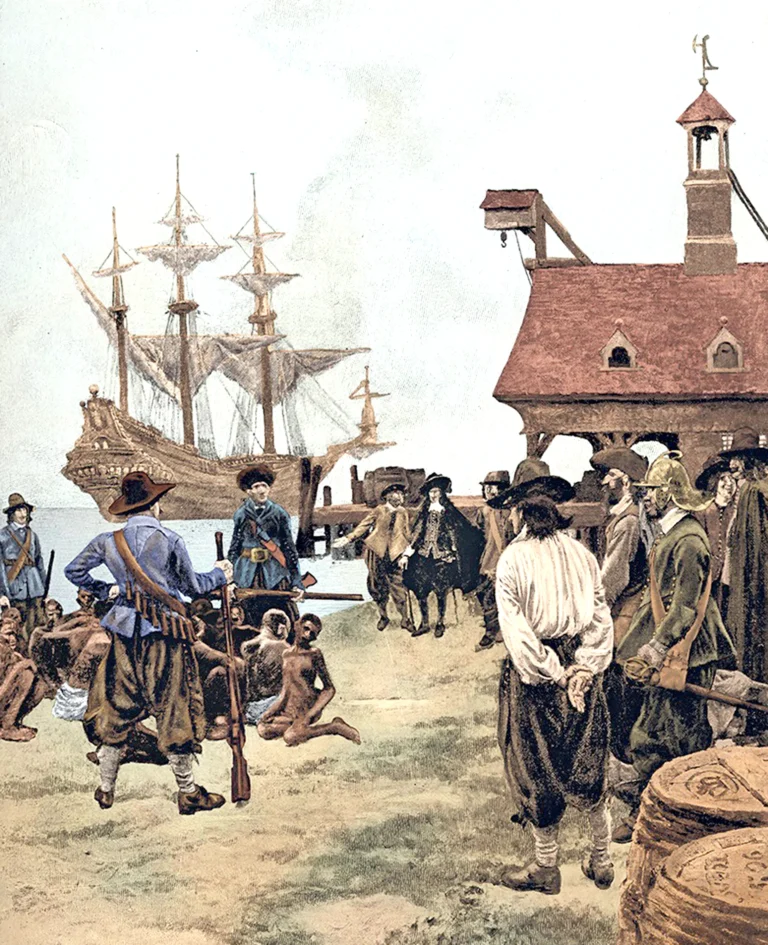
Washington, D.C. – In late August 1619, a private ship arrived at the Jamestown Colony in Virginia. On board were about twenty Africans forcibly taken from their homeland.
This event is considered the symbolic starting point of the history of organized slavery in the English colonies,
which later became the United States of America.
These Africans had been captured in what is now Angola by slave traders
before being transported across the Atlantic by a Portuguese ship.
However, the ship was attacked by two private ships operating under English authority.
They seized a number of the captives and transported some of them to the Virginia Colony in exchange for provisions and supplies.
The enactment of laws that enshrined hereditary slavery
At that stage, slavery laws had not yet taken the form they would later become.
Records indicate that some Africans were initially treated as temporary servants, much like some European laborers.
However, this situation gradually changed in the following decades
with the enactment of laws that established hereditary slavery based on race.
These laws also turned millions of Africans and their descendants into lifelong slaves.
With the expansion of tobacco and then cotton cultivation, the colonies’ reliance on forced labor increased.
This led to the transatlantic slave trade, which transported millions of Africans
from their homelands under inhumane conditions.
This trade resulted in one of the greatest human tragedies in history.
Over time, slavery became a cornerstone of the Southern states’ economy.
However, it also deepened the political and social divisions within the United States
and contributed to the outbreak of the American Civil War between 1861 and 1865.
This war ended with the formal abolition of slavery following the ratification of the Thirteenth Amendment to the Constitution in 1865.
A pivotal moment in American history
Although slavery was legally abolished, its effects persisted for decades through policies of
racial discrimination and segregation between whites and blacks.
Prior to this, the United States witnessed a widespread civil rights movement in the 20th century,
led by prominent activists demanding equality and an end to discrimination.
More than four centuries after the arrival of the first Africans in Virginia,
that event remains a pivotal moment in American history.
It is viewed as the beginning of a long period of slavery and racism.
This period left profound scars that continue to be present in historical and social discussions today.