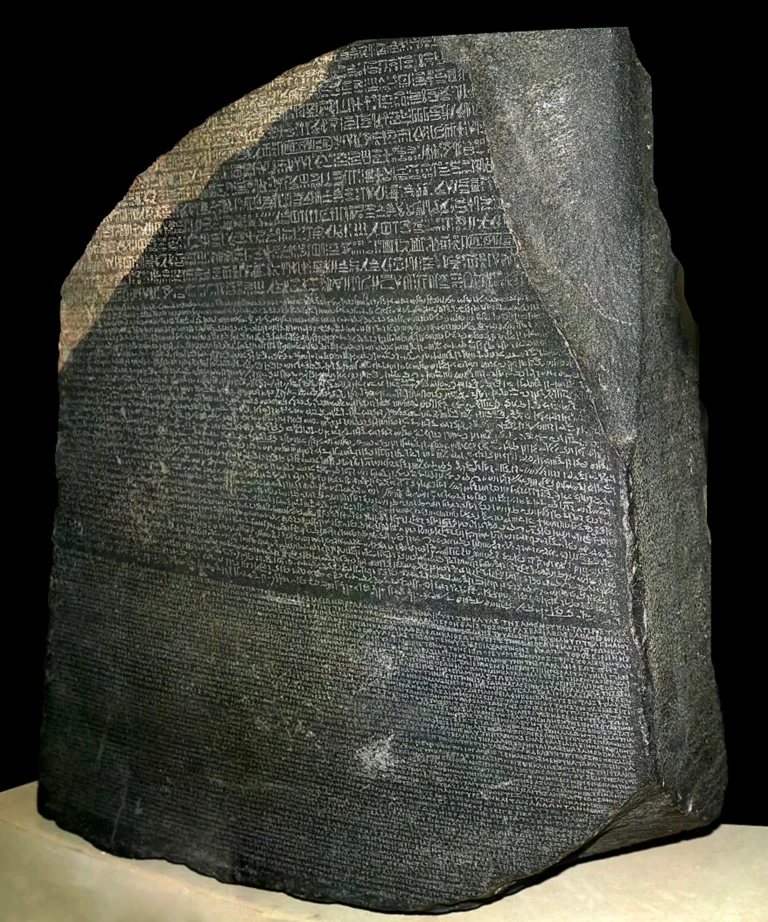
Rosetta, Egypt – The discovery of the Rosetta Stone is one of the most important events in the history of archaeology, as it unlocked the secrets of hieroglyphic writing.
It restored to the world the ability to read the texts of ancient Egyptian civilization
after they had remained enigmatic for over a thousand years.
The story dates back to 1799, during the French campaign in Egypt,
when French engineer Pierre-François Bouchard was overseeing
the fortification work of Fort Julien near the city of Rosetta in the Beheira Governorate.
During the excavation, workers unearthed a block of black granodiorite bearing inscriptions in three different scripts.
Bouchard quickly realized that the piece might be of exceptional historical value.
A unique key to comparing languages
The Rosetta Stone attracted the attention of scholars from the French campaign,
who quickly studied the inscriptions on it.
They discovered that it contained the same text written in three scripts:
hieroglyphic, demotic, and ancient Greek.
Thus, the stone provided a unique key for comparing languages
and attempting to decipher ancient Egyptian writing.
After the defeat of the French forces in Egypt, the Rosetta Stone came
into British possession under the Treaty of Alexandria in 1801.
It was then transferred to the British Museum in London, where it remains on display today.
Egypt continues to demand its return, considering it one of its most important archaeological treasures.
Key revived the language of the pharaohs
The following decades witnessed intensive scientific efforts to decipher the stone,
until the French scholar Jean-François Champollion succeeded in 1822
in interpreting the hieroglyphic system based on the three inscriptions.
This achievement revolutionized the study of ancient Egyptian civilization
and laid the foundation for modern Egyptology.
The Rosetta Stone remains one of the most famous archaeological discoveries in the world.
This is because it was not merely an inscribed piece of stone,
but the key that revived the language of the pharaohs.
It also enabled researchers to read thousands of inscriptions and papyri,
revealing a significant aspect of ancient Egyptian history and its civilization spanning thousands of years.