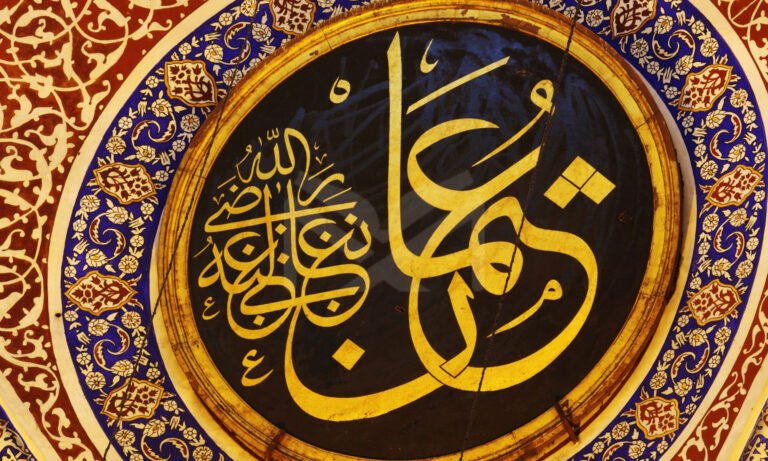
Medina, Saudi Arabia – The assassination of Caliph Uthman ibn Affan, the third Rightly Guided Caliph, is one of the most influential events in Islamic history. This incident marked a major turning point, ending a period of relative stability and opening the door to political turmoil known in historical sources as the “Great Fitna”.
Uthman ibn Affan’s Reign and Achievements
Uthman ibn Affan assumed the Caliphate in 644 AD following the death of Caliph Umar ibn al-Khattab. His reign lasted about 12 years, during which the Islamic state expanded across vast regions in Asia and Africa. His name is also associated with the project of compiling the Holy Quran into a unified copy and sending versions to various provinces to preserve the unity of the Quranic text.
In the final years of his rule, criticisms intensified due to grievances regarding the administration of provinces. Opposition groups exploited this to organize protests in Medina, demanding reforms and the replacement of certain governors.
Details of the Siege and Assassination
The crisis escalated gradually until protests turned into a siege of the Caliph’s home. Despite calls from companions to defend him, the Caliph refused to spill Muslim blood, choosing to avoid armed confrontation within Medina.
The siege continued for weeks amidst mediation attempts, until rebels managed to storm the house. In 656 AD, Uthman ibn Affan was killed while reading the Holy Quran, ending a Caliphate that lasted over a decade.
Consequences of the Assassination on the Political Landscape
The assassination shocked the Islamic world, becoming a profound crisis that affected Muslim unity. After his death, Imam Ali ibn Abi Talib assumed the Caliphate, but disputes over how to handle Uthman’s killers fueled political division.
Historians view Uthman’s assassination as a watershed moment. The repercussions of this incident extended for decades, shaping a new era in Islamic history that remains a subject of study and discussion today.