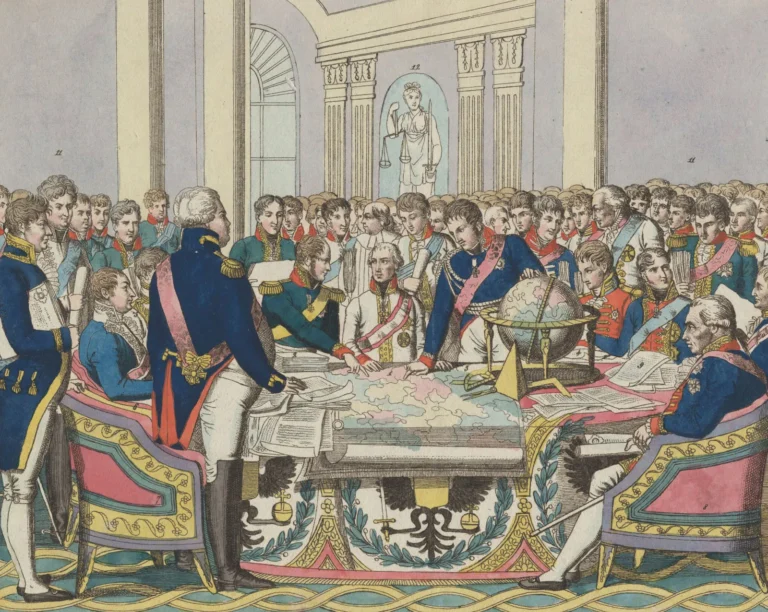
Paris – France — In one of the most heavily debated and analyzed maneuvers in macro-political history, Emperor Napoleon Bonaparte, during his final remaining days in power, deployed an extraordinary legislative blueprint known as the “New Constitution of Liberties.” This dramatic constitutional gamble emerged as a calculated effort to reconstruct his eroding political legitimacy and pacify the compounding domestic resentment fracturing France after long, grueling years of continuous warfare, severe economic exhaustion, and systemic internal instability.
The ‘Hundred Days’ and the Forced Liberal Transition
This sudden, reformist pivot manifested in the volatile year of 1815, aligning with Napoleon’s dramatic escape from his initial exile on the Mediterranean island of Elba—an epoch historically codified as the “Hundred Days.” Upon his return to the mainland, the Emperor was instantly confronted by a drastically transformed geopolitical reality: an uncompromising coalition of European powers mobilizing against him externally, alongside expanding skepticism and fatigue within the French political class and military apparatus alike.
The updated constitution, through which Bonaparte aggressively sought to project a more liberal and collaborative facade of his historically autocratic governance, extended explicit promises to broaden public liberties. It proposed to restructure the institutional equilibrium between executive and legislative branches, and yield a more pronounced governance and auditing mandate to the Parliament. This structural shift was a transparent attempt to offer a more flexible, constitutional alternative compared to the rigid, absolute imperial centralization that defined Napoleon at the absolute apex of his global dominance.
The Waterloo Catastrophe and the Dissolution of the Constitutional Dream
Historians and analysts of the post-Revolutionary era assert that this foundational document, frequently designated in archival records as the “Additional Act,” transcended standard institutional reform. Rather, it functioned as a delayed, desperate diplomatic bridge built between Napoleon and a French society profoundly drained by decades of unceasing conscription, heavy casualties, and fiscal mobilization.
Despite the highly progressive and reformist architecture underpining the text, chronological limits and military realities were entirely stacked against the French sovereign. The geopolitical countdown rapidly culminated in his final, catastrophic military liquidation at the Battle of Waterloo. This definitive defeat abruptly terminated one of the most influential and chaotic military and political experiments in the history of modern Europe, permanently closing the chapter on his constitutional projection before its systemic parameters could ever take root or reshape the administrative landscape of the nation.