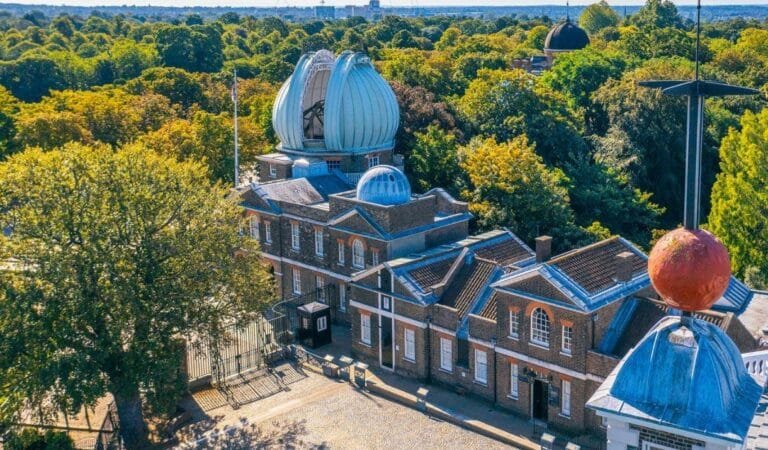
Greenwich – Over the decades, the Royal Observatory, Greenwich, remains a witness to the moment humans decided to unify their clocks and organize movement across the globe. Obviously, as of May 2026, this landmark is no longer just an ancient building but the beating heart of Greenwich Mean Time (GMT). The Prime Meridian (Longitude Zero) passing through it has become the fundamental reference for measuring distance and time geographically, making it the starting point for international navigation and trade for centuries.
“The Seas’ Compass”: How the Stars Led Britain to Establish the Time Standard
The observatory was founded in the 17th century for a purely strategic purpose: securing British maritime voyages by precisely tracking stars to determine positions. Accordingly, the site evolved into a global center for studying planets and the movement of time. Clearly, the major leap occurred in 1884, when the world formally adopted the “Greenwich Line” as the Prime Meridian—a decision that laid the foundation for every navigation system and map we use today in our smartphones and aircraft.
“A Lasting Legacy”: From Scientific Research to a Cultural Icon
Historians believe that turning Greenwich into “Point Zero” was international recognition of Britain’s scientific and naval weight at the time. As a result, even as complex astronomical research moved to more modern technological centers, the observatory retained its status as a cultural symbol embodying the evolution of human thought in understanding time. Amidst this rich heritage, standing on the “Zero Line” in Greenwich remains an inspiring experience, blending the fragrance of history with the scientific precision that governs our modern lives.