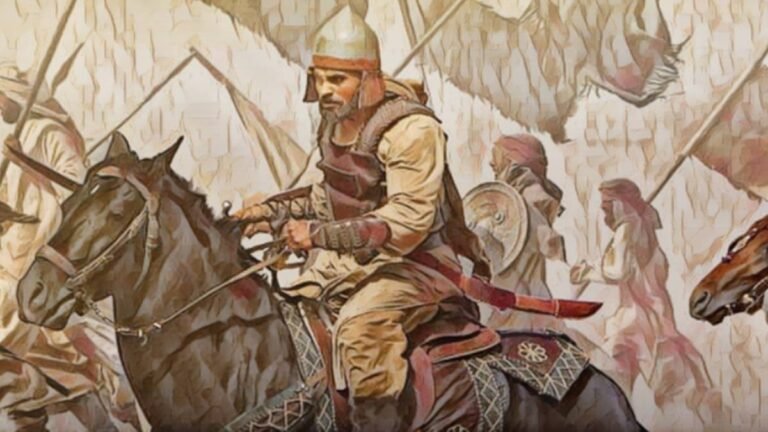
Iraq – With a military brilliance that continues to fascinate analysts, Commander Khalid ibn al-Walid managed to rewrite the history of warfare after flipping the scales in a disproportionate confrontation in Mesopotamia. Obviously, as of May 2026, a re-reading of these events shows that Khalid never relied on “brute force” but rather on a strategy of “mental attrition.” He faced armies that vastly outnumbered his own in men and equipment, yet he transformed the battlefield into a precise “trap” through flexible force distribution and a reserve unit that appeared at the critical moment to decide the fate of the clash.
“The Envelopment Pincer”: How Did Khalid Confuse Enemy Ranks Simultaneously?
Historical accounts reveal the precision of the “double envelopment” tactic executed by the Muslim leader. His units attacked from two different directions at the exact same moment, leading to a total collapse of the opponent’s command and control systems. Accordingly, large formations relying on numerical density disintegrated, finding themselves caught between pincer jaws they never anticipated. Clearly, the success of this tactic relied primarily on “Golden Timing” and superior coordination between units, proving that Khalid ibn al-Walid was ahead of his time in understanding logistics and field movement.
“Leadership Lessons”: When Surprise Becomes Stronger Than Weaponry
Historians believe that Khalid ibn al-Walid’s victories in Iraq were not merely about gaining land but were lessons in “tactical flexibility” and the ability to read the enemy’s mind before they moved. As a result, these battles remain a primary reference in military colleges worldwide on how to exploit terrain and the element of surprise to compensate for numerical deficits. Amidst this extraordinary legacy, the name Khalid ibn al-Walid is cemented as an exceptional leader who knew how to turn massive challenges into decisive victories, immortalizing himself as one of the greatest military minds in human history.