Dubai, UAE – Sheikh Mohammed bin Rashid Al Maktoum, Vice President and Prime Minister of the UAE and Ruler of Dubai, confirmed that the UAE, under the leadership of Sheikh Mohammed bin Zayed Al Nahyan, President of the UAE, continues its ambitious development path. Its position establishes a global model of competitiveness and leadership in various sectors.
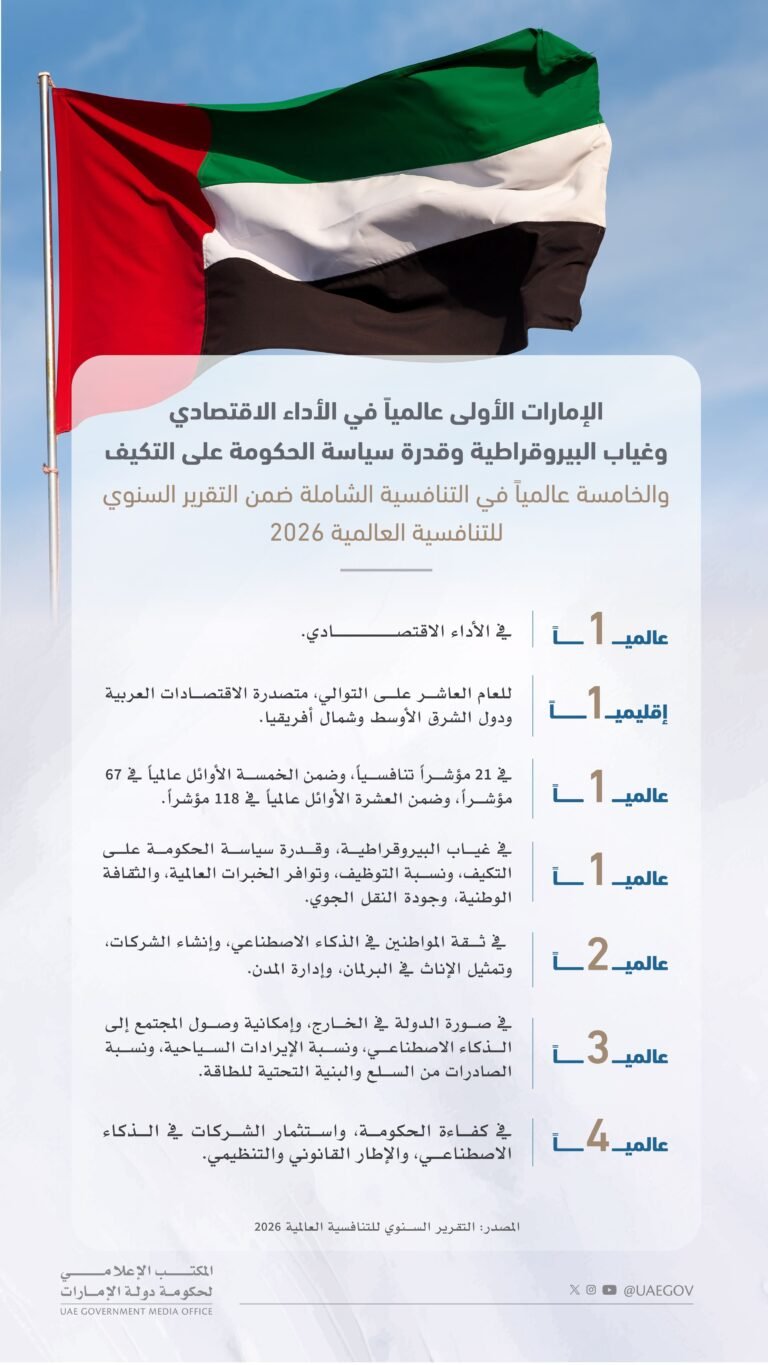
He said: “Under the leadership of my brother Sheikh Mohammed bin Zayed, the UAE continues to consolidate its position among the most competitive countries in the world. According to the latest Global Competitiveness Report 2026, the UAE ranked fifth globally and maintained its regional leadership for the tenth consecutive year. It ranked first globally in economic performance, topping 21 competitive indicators, including the absence of bureaucracy and the government’s policy of adaptation. It is among the top five globally in 67 indicators.
بقيادة أخي الشيخ محمد بن زايد تواصل دولة الإمارات ترسيخ مكانتها بين أكثر دول العالم تنافسية .. ووفق أحدث تقرير للتنافسية العالمية 2026 حلّت الإمارات في المركز الخامس عالمياً وحافظت على ريادتها الإقليمية للعام العاشر على التوالي . . جاءت الأولى عالمياً في الأداء الاقتصادي ، وتصدرت… pic.twitter.com/HNaWWDp6Op
— HH Sheikh Mohammed (@HHShkMohd) June 18, 2026He added: “These results are the result of a national approach, the efficiency of institutions, and the efforts of work teams in various sectors. Our competitiveness is not a temporary goal. Rather, it is an ongoing effort that enhances the quality of life, consolidates global confidence in our country, and confirms that the UAE is steadily moving toward a more prosperous and pioneering future.
He stressed that the UAE will continue to consolidate its position as a destination for investors, an incubator for talents and ambitions, and a success partner for innovators and entrepreneurs. Pointing out that the competitive achievements achieved reflect the strength of the UAE development model and its ability to continue achieving global leadership.
First in the world in economic performance
The UAE achieved outstanding performance in the annual global competitiveness report for 2026 issued by the Global Competitiveness Center of the International Institute for Management Development in Lausanne, Switzerland. It ranked first globally in the economic performance axis, and ranked fifth globally in overall competitiveness.
The country maintained its first regional position for the tenth consecutive year, leading the economies of the Arab region, the Middle East, and North Africa. It ranks fourth globally in government efficiency, corporate investment in artificial intelligence, and the legal and regulatory framework.
The strong performance of a group of vital sectors contributed to the UAE being among the top ten globally in 118 indicators. It ranked among the top five globally in 67 major and minor indicators.
Lack of bureaucracy
The country ranked first globally in 21 indicators, most notably the absence of bureaucracy and the ability of government policies to adapt. Employment rate, availability of global expertise, national culture, extent to which community values support competitiveness, quality of air transport,
It ranked second globally in indicators of citizens’ confidence in artificial intelligence, establishing companies, women’s representation in parliament, and city management. It ranked third globally in indicators of a country’s image abroad and society’s access to artificial intelligence. Percentage of tourism revenues, percentage of exports of goods, energy infrastructure, etc.
These results reflect the progress achieved by the UAE in the areas of the labor market, innovation, digital transformation, and infrastructure. Education and the efficiency of government policies, which enhances their competitiveness at the regional and global levels.
international reference
It is worth noting that the annual global competitiveness report is one of the most prominent international references for measuring the competitiveness of countries, and covers 70 countries around the world. His methodology relies on statistical data and opinion polls including the global business community and private sector leaders, to measure countries’ ability to manage their resources efficiently and achieve sustainable prosperity for their people.
The report is based on four main axes: economic performance, government efficiency, business efficiency, and infrastructure. It includes 20 sub-axes and 342 competitive indicators covering various economic, administrative and social aspects.