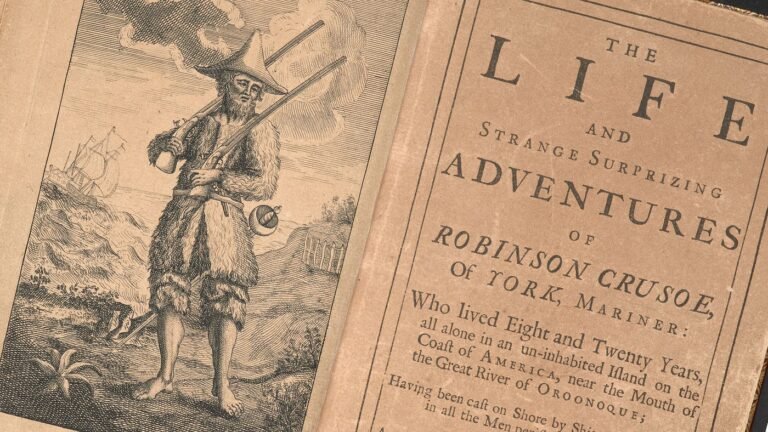
London – More than three centuries ago, specifically in 1719, the novel “Robinson Crusoe” by English writer Daniel Defoe was published, becoming over time one of the most significant literary works in human history. The novel, celebrating nearly 307 years since its publication, remains present in the hearts of readers today and tops the list of world classics. The events revolve around a rebellious young man whose sea adventure ended in a shipwreck, finding himself alone on a remote island. He began an epic struggle for survival, relying solely on his mind and will against a deadly isolation that lasted for many years.
Philosophical and Realistic Dimensions: How Did Defoe Turn Selkirk’s Experience into an Immortal Work?
Robinson Crusoe” was not just a passing adventure story; it was a profound philosophical dissection of self-reliance and the struggle between fear and hope. Obviously, Daniel Defoe succeeded in adding incredible realism to the work by drawing inspiration from the real-life experience of sailor Alexander Selkirk, who lived in isolation for years. As a result, the novel was considered a cornerstone of English realistic literature, as it didn’t just describe nature but dived into the human relationship with the universe and how human will can turn the “impossible” into a tangible reality.
The Symbolism of “Friday” and the Clash of Civilizations: Why the Novel Remains at the Forefront of Literary Discussions
The novel introduced the character “Friday,” who over time became a symbol of a complex relationship between cultures, opening wide discussions that continue today about colonialism, identity, and cultural difference. Critics believe the secret to this work’s immortality lies in its ability to touch the essence of a human being when stripped of masks and left alone to face the world. Accordingly, the novel has been translated into dozens of languages and adapted into hundreds of cinematic works, ensuring that “Robinson Crusoe” remains a story untouched by time because it simply tells the tale of humanity in its weakest moments and its strongest acts of will.