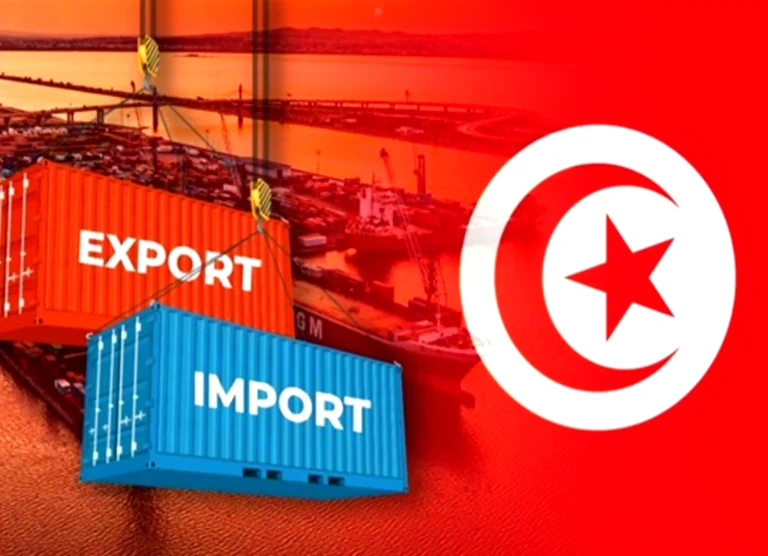
Tunis – Tunisia recorded a significant increase in its trade deficit during the first five months of 2026, reaching 10,415.6 million dinars, compared to 8,365.7 million dinars during the same period in 2025.
Data from the National Institute of Statistics reveals growing pressures stemming primarily
from the rising energy bill. This, in turn, negatively impacted foreign trade indicators.
The ratio of import coverage by exports has declined
According to the institute’s bulletin, the value of exports rose to 28,169.8 million dinars, while imports jumped to 38,585.4 million dinars.
This disparity, resulting from a 5% increase in exports compared to a 9.6% rise in imports,
led to a decrease in the import coverage ratio to only 73%.
In contrast, the ratio was 76.2% last year. This highlights the widening gap
between the pace of foreign consumption and domestic production capacity.
The energy sector: the primary culprit in widening the deficit
The energy sector remains the primary driver of this deficit; the trade deficit in this sector rose
to 5,826.2 million dinars during the first five months of 2026, compared to 4,332.5 million dinars in 2025.
Despite growth in exports of some refined products, energy imports increased by 35.1%.
In contrast, other sectors showed mixed performance; exports of phosphates and their derivatives declined by 31.8%,
while the mechanical and electrical industries and agricultural products recorded positive results.
Geographically, the European Union remains Tunisia’s most important trading partner, receiving 71.5% of exports and 44.2% of imports.
At the Arab level, Tunisian exports saw a significant increase to Egypt and Saudi Arabia.
However, they declined with Maghreb partners (Morocco, Algeria, and Libya).
Experts’ view: A structural crisis requiring radical solutions
Economic affairs specialist Abdel Basset Al-Sammari confirmed that the crisis is not just accounting numbers,
but rather a structural crisis in production, energy and competitiveness.
Al-Sammari explained that the trade deficit, excluding the energy sector, decreases to 4,589.4 million dinars.
He also pointed out that tourism revenues and remittances from Tunisians abroad (6.3 billion dinars)
succeeded in absorbing a large part of the shock, but they are not a substitute for reform.
Al-Sammari stressed that “the real battle is the battle of energy and production,”
considering that relying on remittances from expatriates and tourism
as a first line of defense requires diverting these flows into productive investments.
He stressed that the delay in accelerating renewable energy projects
and improving energy efficiency will remain the main factor that drains hard currency.
For this reason, he called for the need to develop serious policies to enhance the added value of the national economy.
Instead of just dealing with the superficial symptoms of disability.