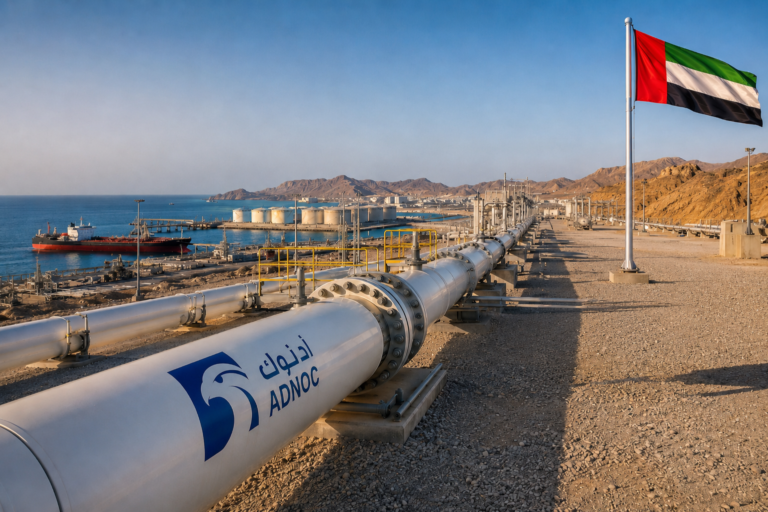
Dubai, United Arab Emirates – Sheikh Khaled bin Mohamed bin Zayed Al Nahyan is Crown Prince of Abu Dhabi and Chairman of the Abu Dhabi Executive Council. He chaired a meeting of the Executive Committee of the Board of Directors of Abu Dhabi National Oil Company “ADNOC”. During the meeting, updates on several strategic projects were reviewed. Chief among these was the accelerated completion of the “West-East 1” oil pipeline.
The Abu Dhabi Media Office announced that the project will strengthen ADNOC’s ability to export crude through the emirate of Fujairah. The pipeline is expected to be operational in 2027. In addition, it will double the company’s export capacity from the eastern coast. As a result, UAE crude will have a wider outlet to global markets.
The project comes as ADNOC continues to develop its oil transport and export network. The company benefits from Fujairah’s strategic location on the Gulf of Oman, outside the Strait of Hormuz. This location provides UAE crude with direct access to international maritime trade routes, particularly toward Asian markets.
From ADNOC’s Board Meeting to the Execution Phase
The review of the project during the meeting of ADNOC’s Executive Committee reflects the pipeline’s importance within the company’s priorities for the coming phase. Notably, it is directly linked to the UAE’s ability to enhance the flexibility of its oil exports. The pipeline will also improve the movement of crude from production and storage areas in Abu Dhabi. Furthermore, it will help move crude to export facilities in Fujairah.
Key execution milestones for the project date back to 2024. In that year, works on sections of the onshore “West-East” pipeline were awarded to China Petroleum Engineering & Construction Corporation. The contract covers sections linking Habshan, Sweihan and Fujairah. Moreover, the implementation period extends over 27 months.
In March 2025, the project entered an important phase with the start of welding works along the pipeline. Welding is one of the main stages in pipeline construction. Subsequently, the latest announcement gave the project additional momentum ahead of its targeted operation in 2027.
The pipeline extends along an onshore route linking production and storage areas in Abu Dhabi with export facilities on the eastern coast. As a result, larger volumes of crude can be transported to Fujairah. This gives ADNOC broader capacity to respond to customer needs and global demand trends.
Fujairah at the Heart of UAE Oil Exports
Fujairah holds a special position in the oil trade, located on an open maritime outlet toward the Indian Ocean and supported by advanced port, storage and marine services infrastructure. Furthermore, with increased oil flows into the emirate, its role as a major regional hub for crude exports, storage and trading is set to grow further.
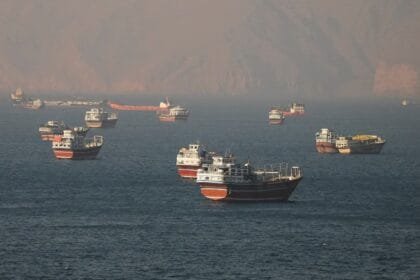
The importance of this route is also highlighted by the sensitivity of the Strait of Hormuz, through which large volumes of oil pass every day. Expanding export capacity from Fujairah gives the UAE greater room to manage crude flows. It also reduces the impact of potential pressure on traditional shipping routes.
The “West-East 1” pipeline builds on an existing system. This system has strengthened the UAE’s ability in recent years to move crude from production areas in Abu Dhabi to the eastern coast. Most notably, this has been achieved through the Habshan-Fujairah pipeline. That pipeline has provided an important route for UAE oil exports.
The project also gives Fujairah a larger role within the UAE energy network. It is not only an export port, but also an integrated hub for storage, marine services and oil trading. This has positive effects on port activity, supply chains and services linked to the energy sector.
A New Push for ADNOC’s Global Presence
The “West-East 1” pipeline is expected to give ADNOC greater ability to meet customer demand in global markets. Furthermore, it will support the international presence of UAE’s Murban crude by expanding transport, export and delivery options.
The project is also set to stimulate wider activity in energy-related sectors, including construction, engineering, marine services and supply chains. At the same time, it will support economic activity in Fujairah as its role in the oil export system continues to grow.
The acceleration of the project reflects the UAE’s commitment to investing in infrastructure capable of keeping pace with changes in the energy market. This involves not only increasing export capacity, but also developing more flexible routes for moving crude to global markets.
With the “West-East 1” pipeline targeted to begin operations in 2027, energy markets are awaiting an important addition to the UAE’s export network. This addition is expected to strengthen ADNOC’s position as a reliable supplier. It will also reinforce Fujairah’s status as a key gateway for UAE crude to global markets.