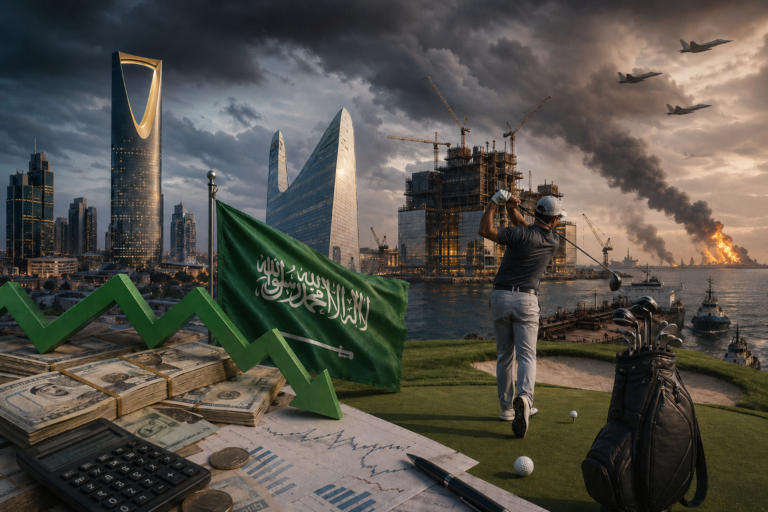
Dubai, UAE – Saudi Arabia’s decision to end funding for the LIV Golf Series after the 2026 season is no longer an isolated sporting event. Rather, it is a new indicator of a broader shift in the Kingdom’s spending policy. This shift comes amid a growing budget deficit and the repercussions of the Iran-Iraq War. There is also the potential closure of the Strait of Hormuz. At the same time, it coincides with an increasing review of mega-projects that have consumed billions of dollars. Most notably, this includes the NEOM project.
The deficit puts pressure on Riyadh’s options.
Saudi Arabia announced a projected budget deficit of approximately 165 billion riyals in 2026, equivalent to $44 billion or 3.3% of GDP. This deficit comes as spending is shifted towards more priority sectors such as industry and logistics. Non-oil revenues are also being increased. The government also estimated a deficit of approximately 245 billion riyals for 2025. This was due to lower oil prices and production levels putting pressure on revenues. Furthermore, spending exceeded planned levels.
This deficit reveals that the era of open-ended financing for mega-projects is drawing to a close. The Kingdom is now required to balance the continuation of its Vision 2030 projects with the financing of domestic obligations. Furthermore, it must maintain financial stability in a more volatile regional environment.
Iran’s war and the closure of Hormuz add a new cost
The closure or near-closure of the Strait of Hormuz, following the outbreak of military conflict with Iran on February 28, 2016, increased pressure on Gulf economies and global energy markets. The strait is one of the world’s most important oil chokepoints. Any prolonged disruption threatens not only oil exports but also the capacity of Gulf producers. Furthermore, it jeopardizes Saudi Arabia’s ability to efficiently utilize its spare capacity.
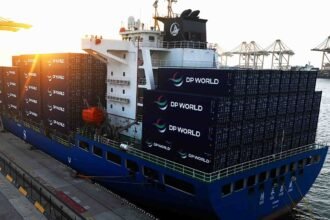
While higher oil prices might theoretically translate into higher revenues for Saudi Arabia, the disruption of the Strait of Hormuz is not a net gain. The closure increases shipping and insurance costs and disrupts supply chains. It also forces the Kingdom to rely more heavily on alternative routes, such as the East-West pipeline, to transport crude oil to Red Sea ports. The U.S. Energy Information Administration has noted that Aramco has previously used this route to reduce its dependence on the Strait of Hormuz. This was important when shipping in the region was disrupted.
Thus, Iran’s war becomes an additional factor in the equation of financial pressure: higher oil prices on one hand, but more complex, costly exports and greater geopolitical risks on the other.
NEOM: The project that swallowed billions
Within this context, the NEOM project stands out as the most striking example of Saudi Arabia’s costly ambitions. Presented as the flagship of Vision 2030, the project was initially estimated at around $500 billion. However, in recent years it has faced increasing questions regarding its cost, timeline, and ability to deliver tangible economic returns.
The Financial Times reports that the Public Investment Fund (PIF) has cut its investments in mega-projects within the Kingdom, including NEOM, by approximately $8 billion. This comes amid rising costs, changes in operational plans, and budgetary pressures.
Other reports also indicated a major review of “The Line,” the linear city within NEOM, following delays and cost overruns. This clearly reflects Riyadh’s shift from announcing symbolic mega-projects to questioning their feasibility. The current questions are: What can actually be achieved? And what is worth pursuing?
“Liv Golf” enters the list of victims
In this context, the decision to halt funding for Liv Golf appears to be the latest indication that Saudi Arabia is beginning to review projects that consume vast sums of money without a clear return. The Public Investment Fund (PIF) confirmed that it will only fund the tournament until the end of the 2026 season. It also explained that the substantial investment required for its long-term continuation is no longer consistent with the current phase of the fund’s strategy, investment priorities, and overall economic conditions.
LIV Golf has been one of Saudi Arabia’s most prominent tools for building global sporting influence, but it has also become an extremely expensive model. The tournament has spent approximately $5.3 billion since its inception. This cost could reach nearly $6 billion by the end of 2026. Prize money is also approaching $30 million per tournament.
From influence to effectiveness
What the Liv Golf and NEOM projects, along with several others under Vision 2030, have in common is that Saudi Arabia has used them to present a new image of the Kingdom and improve its reputation: world-class sport, futuristic cities, tourism, entertainment, and investments outside of oil. However, war, budget deficits, and fluctuating oil revenues have revealed that soft power cannot remain an open-ended, cost-effective endeavor indefinitely.
Saudi Arabia is not giving up on its ambitions, but it is entering a more stringent phase: projects that do not attract private capital, do not offer measurable returns, and do not serve urgent priorities will be the first candidates for reduction, postponement, or suspension of funding.
The decision to halt funding for Liv Golf is not merely sports news; it signals a deeper shift in the Saudi economy. Between budget deficits, the repercussions of the Iran-Iraq War and the potential closure of the Strait of Hormuz, and the costs of NEOM and other mega-projects that have failed, Riyadh appears to be moving from a phase of spending to impress the world. Now, it is shifting to one of holding projects accountable for their viability. In times of financial pressure, global recognition alone is no longer sufficient. What is now required is a return on investment, external financing, and projects capable of standing on their own. These must not rely entirely on the state treasury and its sovereign wealth fund.