- “OPEC” Leadership and Headquarters
- “OPEC” Members
- What Is the Difference Between “OPEC” and “OPEC+”?
- The UAE and the Exit from “OPEC”.. A Significance Beyond Production Figures
- Countries That Withdrew or Suspended Their Membership
- Disputes Within “OPEC” and “OPEC+”.. A Test of the Organization’s Ability to Manage Differences
- Do These Objections Reflect Mismanagement?
- Could Other Countries Follow the UAE’s Path?
- Why Do Some Countries Object?
- The Economic Effects of “OPEC” and “OPEC+” Decisions
- Future Challenges
- Conclusion
Dubai, United Arab Emirates – Since the establishment of the Organization of the Petroleum Exporting Countries, “OPEC“, in Baghdad in 1960, the organization has remained one of the most influential forces in the global energy market. It has played a central role in coordinating production policies among oil-producing countries and in trying to balance the interests of producers and consumers in a market highly sensitive to political and economic fluctuations. “OPEC” was founded by five countries: Saudi Arabia, Iraq, Iran, Kuwait, and Venezuela, before its membership later expanded to include other countries from the Middle East, Africa, and Latin America.
From the beginning, the organization aimed to unify the oil policies of its member states, ensure market stability, secure regular supplies of crude oil, and achieve fair returns for producing countries. Over the decades, “OPEC” has become more than a traditional oil bloc; it has turned into a political and economic platform whose decisions affect fuel prices, transportation costs, inflation rates, and financial markets, especially as oil remains a key component of the global economy despite the growing expansion of renewable energy.
“OPEC” Leadership and Headquarters
“OPEC” is headquartered in Vienna, Austria, where the organization’s Secretariat is based. The Secretariat is the executive body responsible for following up on the organization’s work and implementing the directives issued by its competent bodies. The organization is not run by a permanent president in the executive sense commonly used in companies or governments; rather, the “OPEC” Conference represents the organization’s supreme authority, while the presidency of the Conference is elected on a rotating basis among member states.
Kuwait’s Haitham Al Ghais serves as Secretary General of “OPEC”, making him the organization’s legal representative and the chief executive of the Secretariat. Al Ghais assumed the post in August 2022, and his term was later extended for a new three-year period beginning in August 2025.
This structure reflects the nature of “OPEC” as an intergovernmental organization whose decisions are based on consensus and negotiation among member states, rather than on centralized unilateral management. However, this collective character, despite its political importance, makes the management of disputes more complicated when the interests of producers diverge or when their production capacities and financial needs differ.
“OPEC” Members
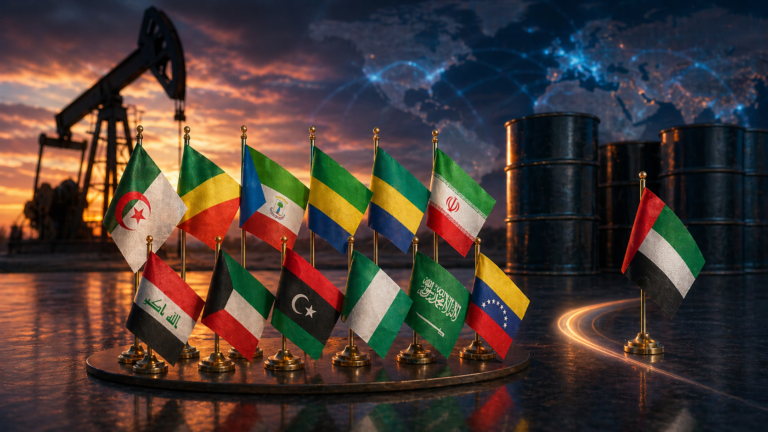
“OPEC” has 12 member states: Algeria, Congo, Equatorial Guinea, Gabon, Iran, Iraq, Kuwait, Libya, Nigeria, Saudi Arabia, the United Arab Emirates, and Venezuela. The organization’s data lists these countries as members, while the UAE has announced its exit from “OPEC” and “OPEC+” as of May 1, 2026.
The UAE’s exit represents an important turning point in the membership map, as it opens a new phase in Abu Dhabi’s relationship with oil alliances and raises questions about the future balance within the organization, especially since the UAE is an influential oil producer with significant production and investment capabilities.
What Is the Difference Between “OPEC” and “OPEC+”?
“OPEC” refers to the original organization that includes oil-producing and exporting member states, while the term “OPEC+” emerged to describe the broader alliance that brings together “OPEC” countries and non-OPEC producers, with the aim of coordinating production levels and responding to market volatility.
This alliance became especially prominent in 2016, when “OPEC” countries agreed with independent producers, led by Russia, to cooperate in managing oil supply. The “OPEC+” framework includes non-OPEC countries such as Russia, Kazakhstan, Azerbaijan, Oman, Bahrain, Brunei, Malaysia, Sudan, South Sudan, and Mexico, with varying levels of commitment and participation from one country to another.
The importance of “OPEC+” lies in the fact that it expanded the ability of producers to influence the market. Decisions to cut or increase production are no longer limited to “OPEC” alone, but now include a wider group of producers, giving the alliance greater weight in confronting oversupply or weak demand.
The UAE and the Exit from “OPEC”.. A Significance Beyond Production Figures
The United Arab Emirates announced its exit from “OPEC” and “OPEC+” as of May 1, 2026, in a move that reflects an important shift in the management of the national energy file and gives the country greater room to shape production policies in line with its current and future capabilities.
“Voice Of Emirates“ had published the news of the decision and prepared reports on its implications, describing it as a notable development in the oil market that is not linked only to production volume, but also to the UAE’s position in the global energy equation, its ability to invest in expanding production capacity, and its management of resources according to a long-term economic vision.
The decision is especially significant because the UAE is not a marginal producer in the market, but a country with advanced oil infrastructure and major operational and investment capabilities. This makes its exit from the “OPEC” and “OPEC+” framework an event whose significance goes beyond the organizational dimension. It also reflects a broader trend among some producing countries toward reassessing the value of committing to collective quotas amid market shifts, growing competition, and diverging interests within oil alliances.
Countries That Withdrew or Suspended Their Membership
The UAE is not the first country to reconsider its relationship with “OPEC”. The organization’s history has witnessed withdrawals and suspensions of membership for various reasons, some linked to quota disputes and others to changing energy priorities or domestic economic transformations.
Qatar withdrew from “OPEC” as of January 2019 after a long membership that began in 1961, explaining the decision by its desire to focus on the liquefied natural gas sector, which represents a central pillar of its economy and energy strategy.
Indonesia also suspended its membership more than once due to its shift into a net oil importer and the incompatibility of its economic and production position with output-cut policies within the organization. Its brief return to “OPEC” in 2016 ended quickly with another suspension of membership.
Ecuador withdrew from the organization in the 1990s, later returned, and then left again in 2020, in a move linked to its desire to increase production and generate higher revenues away from quota restrictions.
In December 2023, Angola announced its withdrawal from “OPEC”, with the decision taking effect in 2024, after a clear dispute over its production quota. Luanda believed that the quota allocated to it did not reflect its national interests or its plans for the oil sector, making withdrawal a more suitable option for its economic direction.
Gabon, meanwhile, withdrew from the organization in 1995, but returned to membership in 2016, making its experience different from countries that left and did not return.
Disputes Within “OPEC” and “OPEC+”.. A Test of the Organization’s Ability to Manage Differences
Most disputes within “OPEC” and “OPEC+” revolve around production quotas and baselines used to calculate cuts or increases. Each country wants a quota that reflects its actual capabilities and future investments, while the alliance seeks to control collective output in a way that supports price stability.
However, repeated objections from several countries, along with withdrawals witnessed by the organization in recent years, raise serious questions about “OPEC’s” ability to manage internal differences and update its mechanisms in line with changing producer interests. The issue is no longer tied to a passing disagreement over a specific production decision; it now reflects a broader governance challenge, especially when member states feel that imposed quotas do not match their production capacity or economic needs.
In recent years, several countries have objected to certain decisions, particularly when they believed that the imposed quotas did not match their ambitions or capabilities. The UAE had previously expressed reservations about some mechanisms for calculating baselines, before announcing its exit from “OPEC” and “OPEC+”.
Angola also stood out as a clear example of a country dissatisfied with the quota allocated to it, eventually leaving the organization. Nigeria, Congo, and other African countries have faced challenges linked to actual production levels falling below previous targets, due to a lack of investment or technical and security problems, making quota recalibration a sensitive issue within the organization.
Disputes are not limited to countries demanding larger quotas. Some countries face criticism for producing quantities above agreed levels, prompting “OPEC+” to demand later compensation plans. This issue has repeatedly involved countries within the alliance, including Iraq, Kazakhstan, and Russia at different stages, as they were asked to compensate for excess production to preserve the credibility of collective agreements. In April 2026, the “OPEC” Secretariat announced that it had received updated compensation plans from Iraq, the UAE, Kazakhstan, and Oman, reflecting the continued sensitivity of the compliance file within the alliance.
Do These Objections Reflect Mismanagement?
It is not enough to describe the situation as merely normal disagreements among producers, nor can it be reduced to a direct judgment of mismanagement. However, repeated withdrawals and objections reveal that the organization faces a clear administrative and structural challenge in how it distributes burdens and benefits among its members.
The wider the gap becomes between countries seeking to protect prices and countries seeking to increase production, the more difficult it becomes to reach collective decisions. And whenever a country feels that its quota does not reflect its production capacity, investments, or financial needs, the likelihood of objection, non-compliance, or reconsideration of membership increases.
From this perspective, “OPEC” appears to be facing a test that is not only about the market, but also about how the market is managed internally. The organization needs to develop more flexible and transparent mechanisms for calculating quotas and baselines, so that technical disputes do not turn into political and organizational crises that threaten its cohesion.
Could Other Countries Follow the UAE’s Path?
The UAE’s exit from “OPEC” and “OPEC+” opens the door to questions about whether other countries may reassess their relationship with the organization or the broader alliance, especially those facing repeated disputes over quotas or pressure related to compensation plans for excess production.
In this context, Kazakhstan and Iraq stand out as cases worth monitoring. Kazakhstan, which is a member of “OPEC+” but not “OPEC”, has faced pressure in recent months because of production overages and required compensation plans. Iraq, meanwhile, remains one of the most sensitive “OPEC” members when it comes to quotas, given its heavy reliance on oil revenues and its broad financial needs. Market analyses suggest that these two countries have come under closer watch after the UAE’s decision, while stressing that Iraq has denied any intention to leave and that Kazakhstan has previously affirmed its commitment to the “OPEC+” agreement.
Nevertheless, there are currently no official indications confirming that any specific country is preparing to exit in the same way as the UAE. Some countries facing pressure inside the alliance still view remaining within “OPEC+” as a political and economic gain, whether through coordination with major producers or through influence over market decisions. Therefore, the more likely scenario at this stage is increased negotiating pressure within the organization, rather than an immediate wave of withdrawals.
Still, the UAE’s exit sets an important precedent for countries that possess production capacity or expansion ambitions and do not want to remain bound by collective quotas they see as inconsistent with their interests. If “OPEC” and “OPEC+” fail to develop more flexible and transparent mechanisms for distributing quotas and calculating baselines, current objections could shift from technical disputes into deeper political reviews of the future of membership.
Why Do Some Countries Object?
Some countries object to “OPEC” and “OPEC+” decisions when they believe that production cuts limit their revenues, especially if they rely heavily on oil to finance public budgets. Others object when they have invested billions of dollars in expanding production capacity, only to find themselves restricted by quotas that prevent them from fully using these capabilities.
Some countries also believe that their domestic circumstances differ from those of major producers. A country facing a financial crisis or needing to finance development projects may prefer to increase production even if that puts pressure on prices. By contrast, other countries tend to support cuts because they benefit from higher prices, even if they sell smaller quantities.
This equation makes “OPEC” and “OPEC+” permanent arenas for negotiation, where official statements are not enough to conceal differences in interests among members. A decision that serves a country with massive production capacity and large financial reserves may not suit a country suffering from declining production or in urgent need of liquidity.
The Economic Effects of “OPEC” and “OPEC+” Decisions
“OPEC” and “OPEC+” meetings may appear technical on the surface, but their decisions have direct effects on economies and markets. Production cuts can support oil prices, which may lead to higher fuel, transportation, and shipping costs, eventually affecting the prices of goods and services.
Increasing production, meanwhile, may help calm prices if demand is stable, but it can put pressure on the revenues of producing countries if the price of a barrel declines. As a result, the organization’s decisions become an important factor in the calculations of governments, companies, and investors, from oil-producing countries’ budgets to the cost of air travel and the prices of imported products.
The importance of these decisions increases during crises, such as wars, tensions in maritime routes, economic sanctions, and slowing global demand, because the market becomes more sensitive to any change in supply.
Future Challenges
“OPEC” today faces challenges that go beyond simply determining production levels. Oil production is growing outside the organization, particularly in the United States, Brazil, and Guyana, alongside accelerating investment in clean energy, changing consumption patterns, and increasing climate pressure on the fossil fuel sector.
“OPEC+” also faces an additional challenge: maintaining discipline among its members. The larger the number of participants, the harder it becomes to reach consensus, especially when national interests differ between those seeking higher prices, those seeking greater production, and those seeking to protect market share.
With the UAE’s exit from “OPEC” and “OPEC+”, the organization enters a new phase that requires a reassessment of internal power balances and of the alliance’s ability to preserve its influence in a market that has become more complex and more diversified in its sources of supply.
Conclusion
The experience of “OPEC” and “OPEC+” shows that the oil market is not managed by numbers alone, but by delicate political and economic balances. Since the organization’s founding in Baghdad in 1960, its stated goal has been market stability, but the path toward that goal has remained shaped by quota disputes, national interests, and changes in the global economy.
Between Qatar’s withdrawal, Indonesia’s suspension of membership, the exits of Ecuador and Angola, and then the UAE’s announcement of its exit from “OPEC” and “OPEC+”, the organization appears to be entering a phase that requires greater flexibility in dealing with its members and a stronger ability to adapt to a market no longer driven only by the decisions of traditional producers.
The wave of objections and withdrawals indicates that “OPEC” is not facing the market challenge alone; it is also facing an internal test related to how it manages divergent interests among countries that differ in production capacity, financial needs, and investment plans. The wider this gap becomes, the greater the need for more flexible and transparent mechanisms, so that technical disputes over quotas do not turn into membership crises that threaten the organization’s cohesion.
Although “OPEC” remains a major player in the global energy equation, the future of its influence will depend on its ability to strike a difficult balance between market stability on one side and respect for the interests of member states on the other.