- Greater flexibility outside the quota system
- A comprehensive review of the production policy
- Expansion of UAE production capacity
- The timing carries a political and economic message.
- Strategic gains for the UAE
- A tough test for OPEC and OPEC+
- A more complex equation for member states
- Potential effects on oil prices
- Declining centrality of traditional alliances
- Summary of the scene
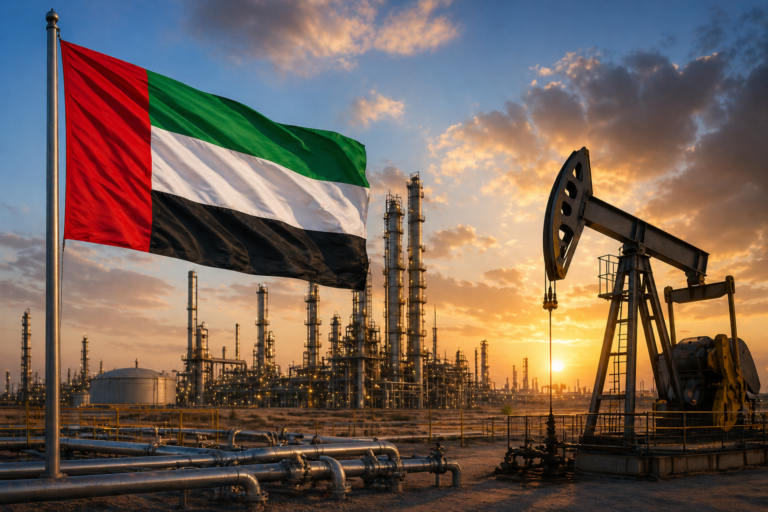
Dubai, UAE – The United Arab Emirates has announced its decision to withdraw from the Organization of the Petroleum Exporting Countries (OPEC) and the OPEC+ alliance, effective May 1, 2026. This move marks a significant shift in the UAE’s energy policy and opens a new chapter in its relationship with global oil markets after decades of participation in one of the world’s most important oil cartels.
According to WAM, the decision aligns with the UAE’s long-term strategic and economic vision and the development of its energy sector. Furthermore, it will accelerate investment in domestic energy production and strengthen the UAE’s role as a responsible and reliable producer in global markets.
Greater flexibility outside the quota system
The decision has implications that extend beyond the regulatory framework of membership, granting the UAE greater latitude in shaping its oil production policy, free from the constraints of collective quotas. It also allows it to operate independently of the reduction or increase mechanisms that govern OPEC+ decisions.
In practical terms, the withdrawal means the UAE will have greater flexibility in managing its production and exports according to its actual capacity, global demand conditions, and its long-term economic interests. However, it emphasizes that any increase in production will be gradual, carefully considered, and aligned with market needs.
A comprehensive review of the production policy
The decision followed a thorough review of the UAE’s production policy and its current and future capacity. This comes at a time of significant geopolitical volatility in global energy markets, particularly in the Arabian Gulf and the Strait of Hormuz. This volatility has direct implications for supply dynamics.
The UAE’s analysis indicates that global energy demand will continue to grow in the medium and long term, necessitating flexible, reliable, and affordable supplies. Abu Dhabi bases its move toward a more independent model for managing its oil resources on this point.
Expansion of UAE production capacity
One of the main drivers of the decision appears to be related to the expansion of the UAE’s production capacity in recent years. ADNOC has announced plans to increase its production capacity of low-carbon-intensity oil to 5 million barrels per day by 2027. This target reflects the scale of investment the UAE has made in the energy sector.
With actual production remaining subject to the quota system within OPEC+, the need for greater flexibility has become increasingly apparent to Emirati policymakers. This is especially true given that the country has developed its production infrastructure to allow it to respond quickly and effectively to market shifts.
The timing carries a political and economic message.
The importance of the move also lies in its timing. Just weeks ago, the UAE was among the eight OPEC+ countries that announced an adjustment to production levels starting in May 2026. At the same time, it affirmed its commitment to market stability and flexibility to increase, stop, or reverse production depending on developments.
Therefore, the UAE’s departure from this framework indicates that Abu Dhabi has shifted from managing disagreements within the coalition to redefining its position outside of it. This also grants it greater flexibility to act according to a national interpretation of its oil and economic interests.
Strategic gains for the UAE
For the UAE, the decision offers direct strategic gains. It enhances its oil policy independence and allows the country to leverage its growing production capacity. Furthermore, it bolsters its ability to meet the needs of major importers with more flexible contracts.
The decision also aligns with a broader economic vision that focuses on maximizing returns from hydrocarbon resources while continuing to invest in gas, renewable energy, and low-carbon solutions. This positions the UAE to combine the roles of a traditional producer and an investor in the energy transition.
A tough test for OPEC and OPEC+
Conversely, the withdrawal presents OPEC and OPEC+ with a difficult test. The UAE is not a marginal producer within the system; rather, it is one of the few countries with significant spare production capacity. This capacity could influence the balance of supply and demand.
The UAE’s withdrawal means that a significant portion of its scalable production capacity will fall outside the collective coordination mechanism. This could weaken the alliance’s ability to control global supply and increase the burden on other producers to maintain market stability.
A more complex equation for member states
As for the OPEC+ member states, they will face a more complex equation. If the UAE gradually increases its production outside the quota system, some countries may have to shoulder a greater burden in managing supply to maintain market balance.
Countries most reliant on oil revenues will be more sensitive to any price decline. Meanwhile, countries with limited production capacity may find their influence within the alliance diminished with the departure of a player capable of significantly increasing supplies.
Potential effects on oil prices
At the level of oil prices, the repercussions do not necessarily appear to be immediate. The global market is currently moving under the influence of strong geopolitical factors, including supply disruptions in the Gulf and the Strait of Hormuz.
In the medium term, the decision could exert downward pressure on prices if the UAE decides to add more volumes to the market once geopolitical conditions stabilize. However, this scenario will depend on the pace of the increase, the level of global demand, and the reaction of other producers both within and outside OPEC+.
In the short term, prices will remain governed by risk factors, navigational security, and continuity of supply, rather than being linked to the UAE’s decision alone.
Declining centrality of traditional alliances
The withdrawal carries a broader message: the balance of the oil market is no longer solely governed by traditional organizations. Major producing countries are now reassessing their membership and alliances based on their investment capabilities, national interests, and partnerships with consumers.
Thus, the UAE’s move appears to be part of a larger global shift. OPEC’s centrality is gradually declining in the face of growing production from countries outside the alliance, increased competition for supply, and changing global energy priorities.
Summary of the scene
Ultimately, the UAE’s withdrawal from OPEC and OPEC+ represents a sovereign decision with profound economic and geopolitical dimensions. It grants Abu Dhabi greater flexibility in managing its production and challenges OPEC to maintain its cohesion and influence. It also ushers in a new phase of rebalancing the oil market between collective discipline and the national interests of producers. While the UAE affirms its commitment to supporting market stability, the decision marks the beginning of a new chapter in Emirati energy policy. This new phase will be characterized by flexibility, maximizing production capacity, and acting in accordance with a national assessment of future global demand.