
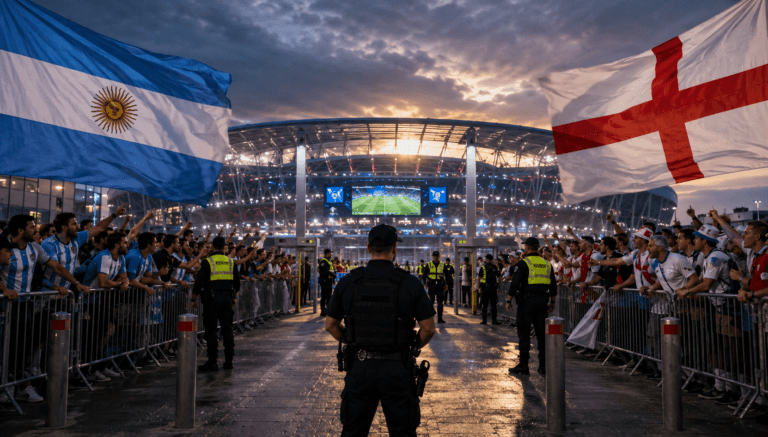
Washington, DC – The world’s attention is focused on Atlanta, Georgia, which will host the 2026 World Cup semi-final between Argentina and England. This match comes amid unprecedented security measures imposed by US authorities and FIFA, due to concerns that the political and historical tensions surrounding the dispute over the Falkland Islands could spill over into the stadium. US security officials, in coordination with the FBI, local police, and FIFA, have designated the match as the “highest risk” of all the tournament’s games. This is due to the complex political and sporting history between the two national teams.
Authorities in Atlanta announced the deployment of approximately 1,600 security personnel in and around Mercedes-Benz Stadium. Police presence will also be increased in fan zones, hotels, and transportation hubs. Furthermore, there will be direct security coordination between U.S. law enforcement agencies and tournament organizers. For the first time in the tournament, separate entrances will be designated for fans of the two teams to minimize potential clashes. Security checks will also be intensified before entry to the stadium.
Argentine Security Minister Alejandra Montoliva confirmed that authorities have agreed with FIFA to ban any banners or slogans of a political, nationalist, or racist nature. This includes banners related to the Falkland Islands dispute, in an effort to prevent the match from being exploited to stir up historical tensions between the two countries.
A historical legacy that goes beyond football
The match carries dimensions that extend far beyond the pitch, as it is linked to one of the most sensitive issues in the history of both countries: the 1982 war between Argentina and the United Kingdom over sovereignty of the Malvinas Islands, known to Britain as the Falkland Islands. Argentina still considers the islands part of its national territory, while Britain asserts its sovereignty over them. This dispute remains politically unresolved to this day and continues to cast a shadow over every football match between the two national teams.
A history of tense confrontations
Matches between the two national teams are considered among the most exciting in world football. This was particularly evident after the 1986 World Cup quarter-final, when the legendary Diego Maradona scored his two infamous goals, one with his hand in what became known as the “Hand of God,” and the other later described by FIFA as one of the greatest goals in World Cup history. Other encounters between the two sides have also been dramatic, including David Beckham’s sending-off in the 1998 World Cup. England later redeemed themselves in the 2002 edition with a 1-0 victory. Wednesday’s match marks the first World Cup meeting between the two teams in over two decades.
Attempts to contain the tension
Despite the tense atmosphere, sports leaders sought to de-escalate the rhetoric before the match. Argentina’s coach, Lionel Scaloni, emphasized that the encounter was “just a football match,” calling for a separation between sports and political disputes. England supporters’ groups also urged their fans to maintain sportsmanship and respect their opponents. Meanwhile, groups of Argentine veterans of the Falklands War issued statements appealing to fans not to turn the match into an arena for settling political scores. These statements stressed that the dispute over sovereignty should remain within the realm of diplomacy, not sports.
Fears of mass clashes
Security concerns intensified after videos circulated during the tournament showing Argentine fans and players chanting slogans related to the Falkland Islands following one of their matches. This sparked widespread criticism in the British media, although FIFA took no disciplinary action at the time. Observers believe the match represents a test of the US security forces’ ability to manage one of the most sensitive encounters in World Cup history. This comes amid expectations that tens of thousands of fans from both teams will be present in the stadium and surrounding areas. Authorities are relying on stringent security measures to ensure the competition remains within the bounds of sportsmanship.