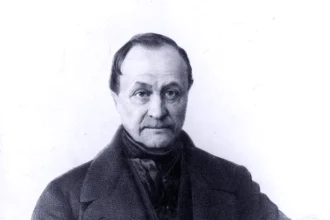

Cairo, Egypt – The name of the French historian and writer Georges Debbing stands out among European figures whose work spanned history, geography, travelogues, and books for young adults.
The influence of some of his works was later transmitted to Arab culture through Rifa’a al-Tahtawi.
Debbing was associated with the cultural scene in 19th-century France,
where he focused on presenting historical and geographical knowledge in a simplified style.
He also left behind a number of books aimed at children and young adults.
At that time, educational writing for this demographic was gaining increasing popularity in Europe.
Books for young people
Debbing work wasn’t limited to historical studies; he also focused on presenting stories
and knowledge in a way that was suitable for children and young adults.
He wrote a number of books that addressed literary, educational, and geographical topics.
This aspect of his work reveals the nature of the European interest at that time in simplifying science and knowledge.
This trend transformed it into material that young people could benefit from, rather than confining it to specialized books.
How did Debbing reach Rifa’a al-Tahtawi?
The significance of Debbing for Arab culture lies in the fact that one of his works
caught the attention of Rifa’a al-Tahtawi during his time in France.
Al-Tahtawi came across a book that dealt with the customs, morals, and conditions of various peoples,
and he found it to be a valuable source of knowledge.
He then undertook its translation into Arabic, resulting in the book being published
under the title “Necklaces of Glory in the Strange Customs of the Ancients and the Moderns.”
Al-Tahtawi’s translation of this work was not merely a linguistic exercise,
but rather part of a broader intellectual project.
This project aimed to introduce Egyptian and Arab readers to new ideas
and knowledge he had encountered during his travels in Europe.
Translation is a gateway to renaissance
The significance of the relationship between Debbing and Tahtawi extends beyond
the book itself to the role translation played in shaping modern Egyptian consciousness.
Tahtawi was a leading figure in the translation movement in Egypt, striving to benefit from European sciences and ideas.
He also worked to adapt them into Arabic and adapt them to the Egyptian cultural context.
Intellectual exchange between East and West
Through these efforts, some European works became bridges for intellectual exchange between East and West,
contributing to the introduction of new topics, terms, and ideas into the Arabic library.
Thus, the story of George Debbing and Rifa’a al-Tahtawi represents one of the links in
the chain of cultural interaction that accompanied the beginnings of the modern Egyptian renaissance.
During that era, ideas from European books were transmitted to the Arab reader
through the efforts of translators and intellectuals.
These individuals recognized that translation could be a means of building knowledge
and broadening the horizons of society.