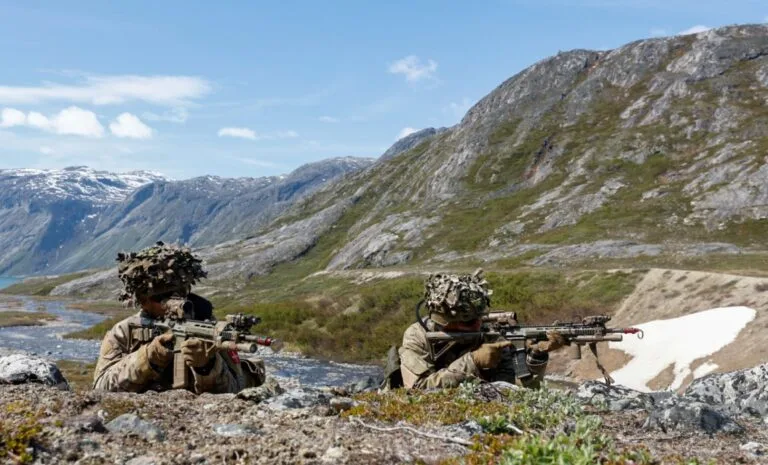
Reykjavik, Iceland – American publication Politico reported that the declining leadership role of the United States within NATO was clearly demonstrated during the “Northern Viking” exercise in Iceland, after European and Canadian forces participated in drills tracking Russian submarines without the involvement of US ships or aircraft in the naval segment of the exercise, according to the report.
Exercise Without Direct US Leadership
The drills featured German reconnaissance aircraft, Canadian warships, and Belgian fighters under the command of French Rear Admiral Nicolas Molitor, in an effort to showcase the ability of European allies and Canada to bolster North Atlantic security even with a reduced direct US military presence. Icelandic Defense Minister Jónas Allasson stated, according to Politico, that Europe and Canada are assuming greater responsibilities, noting that the absence of US ships and aircraft was striking in an exercise where Washington traditionally played a primary role.
Strategic Significance of the GIUK Gap
Iceland is located near the “GIUK gap” spanning Greenland, Iceland, and the United Kingdom—a strategic maritime passageway utilized by Russian submarines to reach the Atlantic Ocean from their bases on the Kola Peninsula. NATO nations view controlling this gap as a core element in safeguarding the North Atlantic, particularly amid growing concerns regarding Russian military capabilities and potential threats to critical undersea infrastructure, including internet cables and energy pipelines.
Washington Has Not Fully Withdrawn
Despite the absence of US ships and aircraft from the naval part of the exercise, the American presence in Iceland has not vanished entirely, as US Navy engineers participate in constructing new facilities inside the military section of Keflavik Airport, and the US contributed to planning the exercise. Politico noted that US ships led the exercise two years ago, but the deployment of a large portion of US naval forces elsewhere—including the Middle East and the Caribbean—contributed to highlighting the European and Canadian role in the North Atlantic. This coincides with rising European concerns over Russian activity, rendering the reinforcement of allied capabilities in the region increasingly vital for the security of transatlantic shipping lanes and infrastructure.