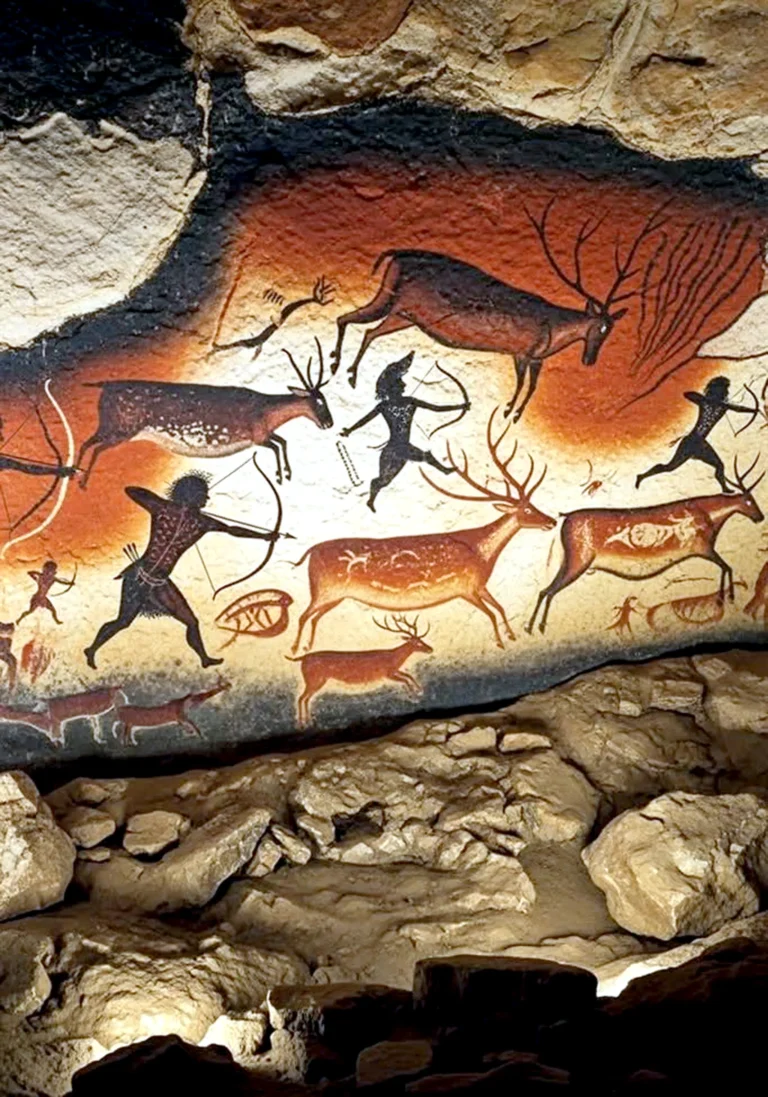
Cairo, Egypt – The caves paintings left by ancient humans were more than just engravings documenting their daily lives or depicting the animals they saw around them.
Studies suggest that some of these paintings may have been designed to appear as if they were moving when exposed to fire light.
Flames inside caves were constantly moving. Because of this, the shadows and light on the walls changed.
As a result, parts of the paintings may have appeared and disappeared sequentially before the viewer’s eye.
This, in turn, gave the depicted animals an illusion of movement.
Nature of the drawings on the cave walls
Researchers believe that prehistoric humans may have utilized the uneven nature of cave walls
and the flickering light of fires to create visual effects in their artwork.
This is a rudimentary form of visual storytelling, similar to the concept of sequential image projection underlying modern cinema.
This hypothesis opens the door to a re-examination of the function of cave art.
It may not have been solely a means of drawing and documentation,
but also an early form of visual storytelling that relied on the interplay of drawing, light, shadow, and the movement of the viewer.
Ancient Man and the Concept of Modern Cinema
Although describing these experiments as “cinema” remains metaphorical
and does not imply that ancient humans possessed the modern concept of cinema,
they do reveal an early understanding of how the eye works and the effect of changing light on image interpretation.
While the world needed thousands of years to develop cameras, projectors, and digital screens,
ancient humans may have begun, on cave walls and with the help of firelight,
their first experiments in making still images appear to move.