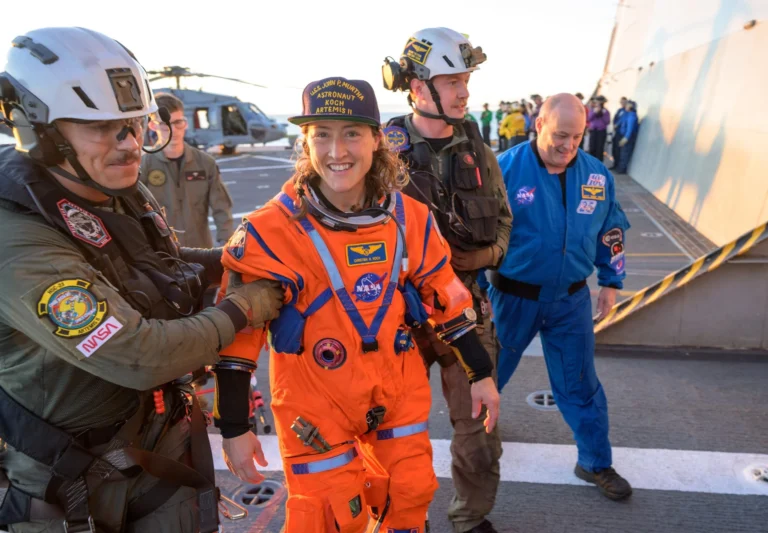
Houston – American astronaut Christina Koch revealed the details of her difficult physical and psychological recovery journey after returning from the “Artemis 2” lunar mission, emphasizing that the real challenge wasn’t just in space but in “returning to Earth.” Koch explained that the human body needs significant time to regain its natural balance after zero-gravity environments. She noted that she underwent an intensive rehabilitation program to regain physical fitness and readapt to Earth’s gravity, a phase she described as one of the most challenging periods in her professional career.
The “Post-Return” Challenge: How Do Astronauts Readapt to Daily Life?
Koch emphasized that the effects are not limited to the physical side but extend to the psychological state, as astronauts need gradual readaptation to daily life after spending long periods in an isolated environment completely different from our planet. Obviously, the medical and psychological support provided by “NASA” played a pivotal role in facilitating this stage through physical exercises and continuous health assessments. As a result, Koch’s experience highlights the importance of “mental health” for astronauts as an integral part of the success of long-term space missions, away from the spotlight of launch and landing.
Artemis 2 and Paving the Future: “Recovery” Lessons Shape the Path Back to the Moon
The “Artemis 2” mission is the cornerstone of the United States’ program to return to the Moon, making the astronauts’ personal experiences after returning vital data for developing future manned missions. Experts believe that Koch’s sharing of these details gives scientists a deeper understanding of space’s long-term effects on humans. Ultimately, Christina Koch’s story reflects that reaching space is not the end of the journey, but the beginning of a completely different test on Earth, in an attempt to restore human balance after a unique adventure beyond the planet’s borders.