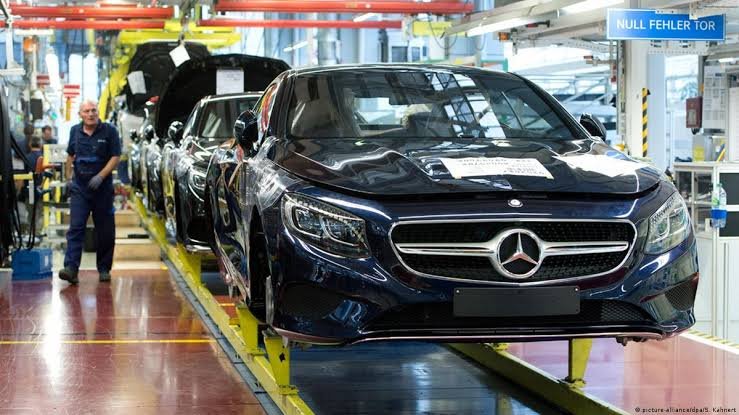
Berlin, Germany – In a sharp escalation of the crisis gripping Germany’s automotive industry, the IG Metall union has called on workers to stage massive protest marches outside Mercedes-Benz plants nationwide. This action comes in response to recent management decisions aimed at urgently cutting costs, including delaying the payment of essential bonuses to thousands of employees.
Austerity measures anger the workforce
The crisis began after a letter from the Mercedes-Benz board of directors to employees in Germany late last week, confirming that the company’s economic situation in the German market was “extremely critical.” The board indicated that this necessitated “continuing to reduce costs at maximum speed” to maintain competitiveness.
Based on these developments, the company decided to postpone the payment of the exceptional bonuses agreed upon in the collective agreement for July. This decision directly affects approximately 90,000 of its 108,000 employees in Germany. This bonus, known as the “transition supplement,” is equivalent to 18.4% of the monthly salary. The company explained that the payment of these amounts has been deferred to next year. This measure has angered labor unions, particularly given the inclusion of clauses that allow for the complete cancellation of these bonuses should companies face financial difficulties.
“A hot summer” in the automotive sector
Workers’ anger was not limited to the postponement of bonuses, but also extended to news that management was considering the option of obliging employees to work additional hours without additional financial compensation. The union considered this an unacceptable transgression. IG Metall called for widespread protests in major manufacturing centres, including the Sindelfingen, Unterturkheim, Stuttgart, Bremen, Berlin, Hamburg, Germersheim, Rastatt and Copperheim plants.
In a strongly worded statement, union president Christiane Bonner warned that “IG Metall, its factory workers, and suppliers are in for a difficult summer and autumn if management continues to focus on job cuts and transfers instead of seeking fundamental solutions.” The union emphasized in its statement that workers are “exhausted and will no longer accept being blamed for management’s mistakes and the geopolitical conflicts that are exacerbating the crisis.” It stressed that workers are not responsible for the company’s current financial situation.
A structural crisis in the German sector
The Mercedes-Benz crisis comes amid a broader downturn in the German automotive industry. Other major companies, such as BMW and Volkswagen, have announced similar job cuts. Estimates suggest that Volkswagen alone could face losses of up to 100,000 jobs.
This situation reflects the uncertainty gripping the heart of the German economy. Workers find themselves directly confronted by austerity policies imposed by management to meet the challenges of global competition. This foreshadows escalating labor tensions in the coming months unless compromises are reached that satisfy both sides of the industrial equation.