
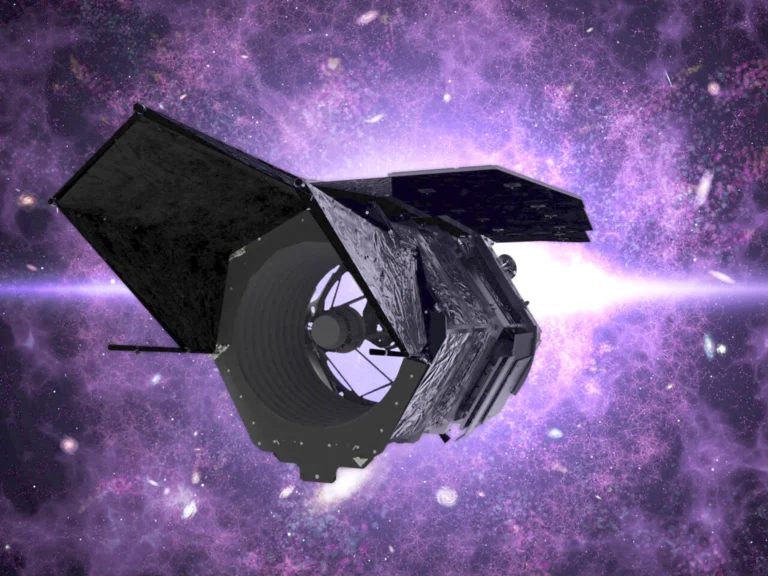
Washington, DC – NASA is preparing to launch the Nancy Grace Roman Space Telescope on August 30th, in a scientific mission considered one of the most important projects for exploring the universe in recent years.
The telescope’s advanced capabilities will allow scientists to observe vast areas of space with unprecedented precision.
The telescope is named after the American astronomer Nancy Grace Roman,
who played a pivotal role in developing space programs
and is sometimes called the “mother of the Hubble Telescope” in recognition of her contributions to modern astronomy.
The telescope focuses on studying dark energy
Roman will boast a field of view approximately 100 times wider than the Hubble Space Telescope,
while maintaining a high degree of resolution.
This will allow it to scan vast areas of the sky in record time, observing millions of galaxies, stars, and distant planets.
The telescope is expected to focus on studying dark energy, believed to be responsible
for the accelerating expansion of the universe,
as well as searching for dark matter and observing thousands of exoplanets using gravitational lensing technology.
This could contribute to the discovery of new Earth-like worlds.
The telescope will also provide massive amounts of data that will help scientists track
the evolution of galaxies over billions of years and understand how the cosmic structure
formed from the earliest stages of the universe’s existence.
A new step in the journey of space exploration
Space experts believe that the Roman mission will complement the achievements of both Hubble and James Webb.
While Hubble will survey the sky on a vast scale, James Webb will study the objects it discovers in greater detail,
giving scientists a more comprehensive picture of the universe.
NASA hopes the mission will help answer long-standing scientific questions that have puzzled researchers,i
ncluding the nature of dark matter and dark energy, and the possibility of habitable planets outside our solar system.
The launch of the Roman telescope represents a new step in space exploration.
Scientists expect it to revolutionize our understanding of the universe and open up unprecedented horizons
for astronomical discoveries that could significantly alter prevailing scientific concepts.