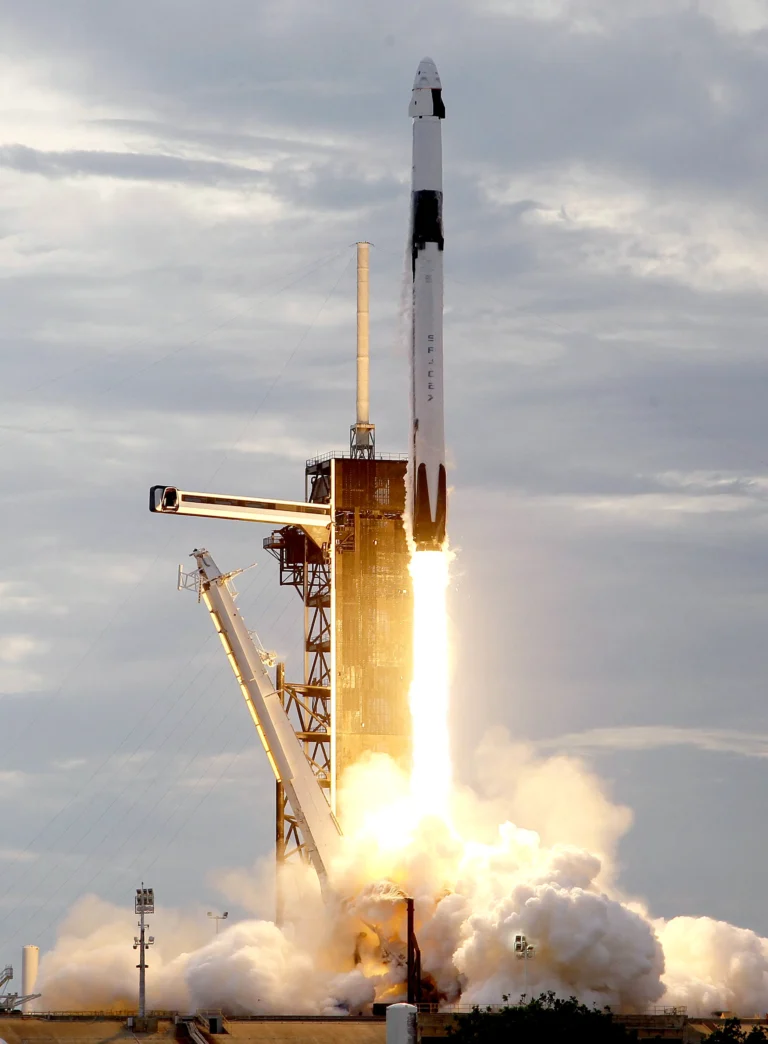
Washington, DC – NASA has selected SpaceX’s Falcon Heavy rocket to launch a new scientific mission aimed at monitoring space weather.
This move reflects the growing reliance on commercial rockets to carry out complex space missions.
It also enhances scientists’ ability to predict solar storms and their effects on Earth.
The mission aims to send a space observatory equipped with advanced instruments to monitor solar activity, including solar flares and coronal mass ejections.
These phenomena release enormous quantities of charged particles toward Earth. When they arrive, they can disrupt satellites, communication and navigation systems, and power grids.
Falcon Heavy is one of the most powerful rockets in the world
The Falcon Heavy rocket is one of the most powerful rockets currently in operation in the world. Its ability to carry heavy payloads to deep orbits makes it a suitable choice for scientific missions that require sending spacecraft to observation points far from Earth.
The mission will collect precise data on the solar wind, the magnetic field, and high-energy particles. With this data, scientists will be able to develop more accurate models for predicting space weather.
It also gives satellite operators and power grids more time to take preventative measures before solar storms arrive.
Space experts emphasize that the importance of monitoring space weather is increasing with the growing reliance on space technologies.
In the event of powerful solar storms, these storms can disrupt internet and communication services.
Furthermore, they can disrupt global positioning systems and, in some cases, even cause widespread power outages.
Artemis… and returning humans to the moon
This mission also strengthens the ongoing collaboration between NASA and SpaceX, which has become a key partner in launching scientific and crewed missions.
SpaceX also plays a role in transporting astronauts and supplies to the International Space Station and is involved in the Artemis program, which aims to return humans to the Moon.
Experts believe the new mission will provide crucial scientific data for understanding the relationship between the Sun and Earth.
It will also contribute to protecting technological infrastructure and future space missions. This comes as solar activity continues to reach high levels during the current solar cycle.