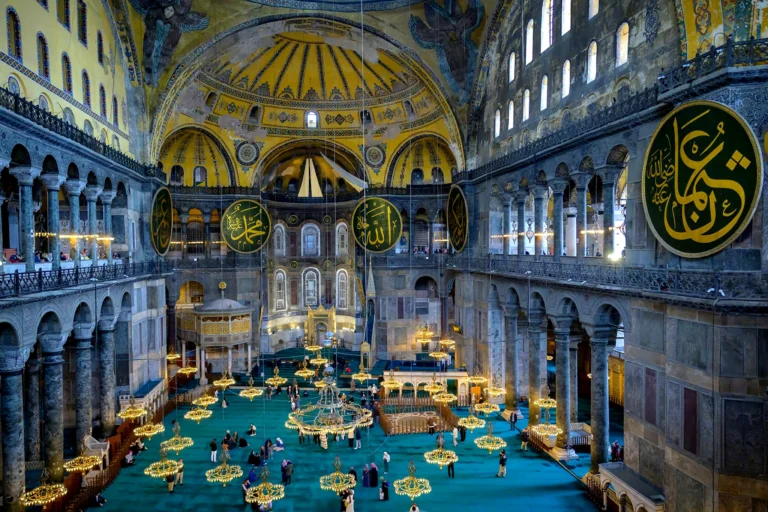
Istanbul, Turkey – The world commemorates the reopening of Hagia Sophia as a mosque, a historic step that ended 86 years of its closure for prayer services, after serving for decades as a museum open to visitors from around the globe.
Hagia Sophia is one of the world’s most prominent historical and religious landmarks.
Built in the 6th century AD by order of the Byzantine Emperor Justinian I,
it was inaugurated in 537 AD as the largest cathedral in the world at the time
and served as the seat of the Eastern Orthodox Church for nearly a thousand years.
A destination for millions of tourists and researchers
Following the conquest of Constantinople in 1453 by the Ottoman Sultan Mehmed the Conqueror, the building was converted into a mosque,
with the addition of minarets, a mihrab (prayer niche), and a minbar (pulpit).
It continued to serve its religious function for over four and a half centuries,
becoming one of the most prominent symbols of the Ottoman Empire.
In 1934, the Turkish government, under the leadership of Mustafa Kemal Atatürk,
issued a decree converting Hagia Sophia into a museum.
The decree took effect the following year, halting prayers within its walls and transforming it into a destination
for millions of tourists and those seeking history and unique architectural treasures.
The status of Hagia Sophia remained a subject of extensive debate for decades
until the Turkish Council of State overturned the museum conversion decree in July 2020,
declaring the building a registered endowment (waqf) as a mosque.
Subsequently, the Turkish Presidency issued a decree reopening it for worship.
Restoring the building’s historical identity
On July 24, 2020, the first Friday prayer in 86 years was held inside Hagia Sophia,
attended by thousands of worshippers and Turkish officials.
The event garnered global attention and elicited mixed reactions,
with supporters viewing it as a restoration of the building’s historical identity,
while opponents argued it could diminish its global cultural significance.
Despite its reconversion into a mosque, Hagia Sophia remains
a UNESCO World Heritage Site and continues to welcome visitors from around the world.
It preserves its Byzantine decorations and historical mosaics alongside its Islamic character,
standing as a testament to the succession of civilizations and empires across nearly 15 centuries of history.