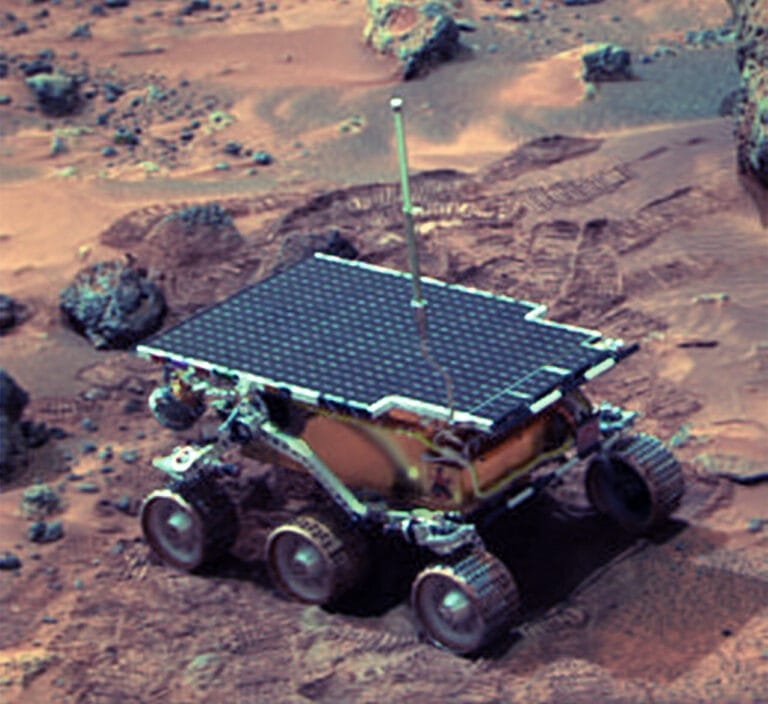
Washington – The “Mars Pathfinder” mission is considered one of the most prominent achievements in the history of space exploration, following NASA’s successful landing on the surface of Mars on July 4, 1997. This step revitalized the exploration programs of the Red Planet after decades of challenges, laying the foundation for a new era of robotic exploration.
Innovative and Low-Cost Technical Vision
The mission was part of an ambitious program that aimed to develop low-cost and high-efficiency means for deep space exploration. The mission was not just a landing attempt, but a comprehensive technical experiment that carried the small rover “Sojourner,” which made history as the first mobile robotic vehicle to operate on the Martian surface. This achievement opened the door for a whole generation of rovers sent by NASA in subsequent years, changing the concept of space missions from stationary to mobile.
Bold Landing and Perfect Site Selection
NASA chose the “Ares Vallis” region as the landing site for the spacecraft, based on scientific estimates indicating that this region had witnessed massive water flows in the past, making it an ideal place to study the history and geology of the Red Planet. After a successful landing that relied on an innovative and surprising system using parachutes and airbags to mitigate impact force, the spacecraft began sending images and scientific data back to Earth. The “Sojourner” rover moved flexibly between rocks, capturing high-quality images and conducting precise analyses of rock and soil composition, a technical achievement that captured the world’s attention.
Scientific Legacy Exceeding Expectations
The mission provided thousands of images and scientific measurements that helped researchers understand the nature of the Martian surface and its geological evolution. The results obtained reinforced evidence that the planet had witnessed water activity in the past, leading to increased interest among scientists in searching for indicators of possible ancient life. Although the mission was designed to operate for about a month, the lander and rover continued to send data for much longer than expected, proving the efficiency of the design and its durability in the harsh conditions of the Red Planet.
Cornerstone for Future Missions
Space experts confirm that the success of “Mars Pathfinder” was a pivotal turning point in Mars exploration programs. This mission paved the way, both technically and scientifically, for more advanced and challenging missions, such as “Spirit,” “Opportunity,” “Curiosity,” and “Perseverance.” These subsequent missions continued to reveal the secrets of the Red Planet, relying on the data and experience derived from “Pathfinder,” cementing its position as one of the most important milestones in the history of human space exploration.